NPS Formula Calculator: Find Your Score in Seconds
Use our NPS formula calculator to get your Net Promoter Score instantly. Learn the formula, interpret your score, and avoid common calculation mistakes.
Posted by
 Backsy
Related reading
9 Essential Customer Satisfaction Measures To Stop Guessing
Stop guessing. Here are 10 battle-tested customer satisfaction measures with formulas, pros, cons, and real examples to prove what works.
Your Growth Is A Lie. Here's The Math That Proves It.
Stop bleeding users. Learn how to calculate, benchmark, and actually improve your customer retention rate with no-BS strategies that prevent churn.
Stop Asking Your Customers What They Want. They're Already Screaming It.
Tired of generic advice? Discover real customer retention best practices from a founder who’s been in the trenches. No fluff, just what works.
Stop guessing. You need your Net Promoter Score, and you need it now. This simple NPS formula calculator does one thing well: it runs the standard formula—(% Promoters - % Detractors)—to give you an instant snapshot of your customer loyalty. No fluff. Just the number.
Your Instant NPS Formula Calculator
No spreadsheets, no manual math. Plug in your promoter, passive, and detractor counts right here and see where you stand.
[CALCULATOR WIDGET EMBED HERE]
Got your score? Good. Now, what does that number actually mean? That's your starting line. The real work is turning that single metric into a weapon for your business.
Decoding the Three Customer Tribes
Every NPS response slots a customer into one of three buckets. Each one has a totally different relationship with your brand. Messing them up is a recipe for disaster.
| Segment | Score Range | What They Really Are |
|---|---|---|
| Promoters | 9–10 | Your unpaid sales team. They’re loyal, enthusiastic, and the engine for your organic growth. |
| Passives | 7–8 | Satisfied, but not loyal. They're ticking time bombs waiting for a better offer from a competitor. They won't trash you, but they sure won't defend you. |
| Detractors | 0–6 | Your active brand saboteurs. They’re a churn risk and can poison your reputation with negative word-of-mouth. |
Understanding these groups isn't academic. It's how you decide who to learn from, who to save, and who to clone.
This calculator is effective because it delivers immediate value, unlike the static PDFs that explain why static lead magnets fail. Now, let’s break down the math you just used.
How to Calculate Your NPS Score (The Bare Metal)
The math behind the Net Promoter Score isn't some black-box algorithm. It’s a blunt instrument designed to give you a quick, sometimes painful, look at where you stand. It’s a tug-of-war between your fans and your haters.
The formula is dead simple:
NPS = % Promoters - % Detractors
You’ll notice the Passives (scores 7-8) are completely ignored. They’re neutral. They don't hurt your score, but they sure as hell don't help it. They're just… there. For now.
A Real-World Example
Let's run the numbers. Imagine your SaaS company just surveyed 250 customers.
Here's the breakdown:
- Promoters (9-10): 115 customers
- Passives (7-8): 85 customers
- Detractors (0-6): 50 customers
First, convert those counts to percentages:
- Promoter Percentage: (115 / 250) * 100 = 46%
- Detractor Percentage: (50 / 250) * 100 = 20%
Now, plug them into the formula:46% (Promoters) - 20% (Detractors) = 24
Your Net Promoter Score is 24. Not a percentage. It’s an absolute number on a scale from -100 to +100. A 24 means you have more fans than critics, but it also means a fifth of your customers are unhappy enough to be a problem.
Actionable Takeaway: Stop treating NPS as a vanity metric. A positive score means you're not dead, but the real work starts when you obsess over why that 20% are Detractors.
Spreadsheet Formulas to Stop Wasting Time
Don't calculate this manually. Use a spreadsheet. Copy one of these formulas and replace the placeholders with your cell references (e.g., A2, B2).
Google Sheets:=((Promoter_Count / Total_Responses) - (Detractor_Count / Total_Responses)) * 100
Excel:=((Promoter_Count/Total_Responses)*100) - ((Detractor_Count/Total_Responses)*100)
While NPS is a solid starting point, it's just one of several critical customer satisfaction measures. It tells you what your score is, not why.
So, What's a "Good" NPS Score Anyway?
Your NPS formula calculator spits out a 25. Or a 45. Is that good? The blunt answer: without context, your NPS score is a useless vanity metric.
Chasing an arbitrary number like "+50" is a founder mistake. The only things that matter are your direct competitors and your own past performance.
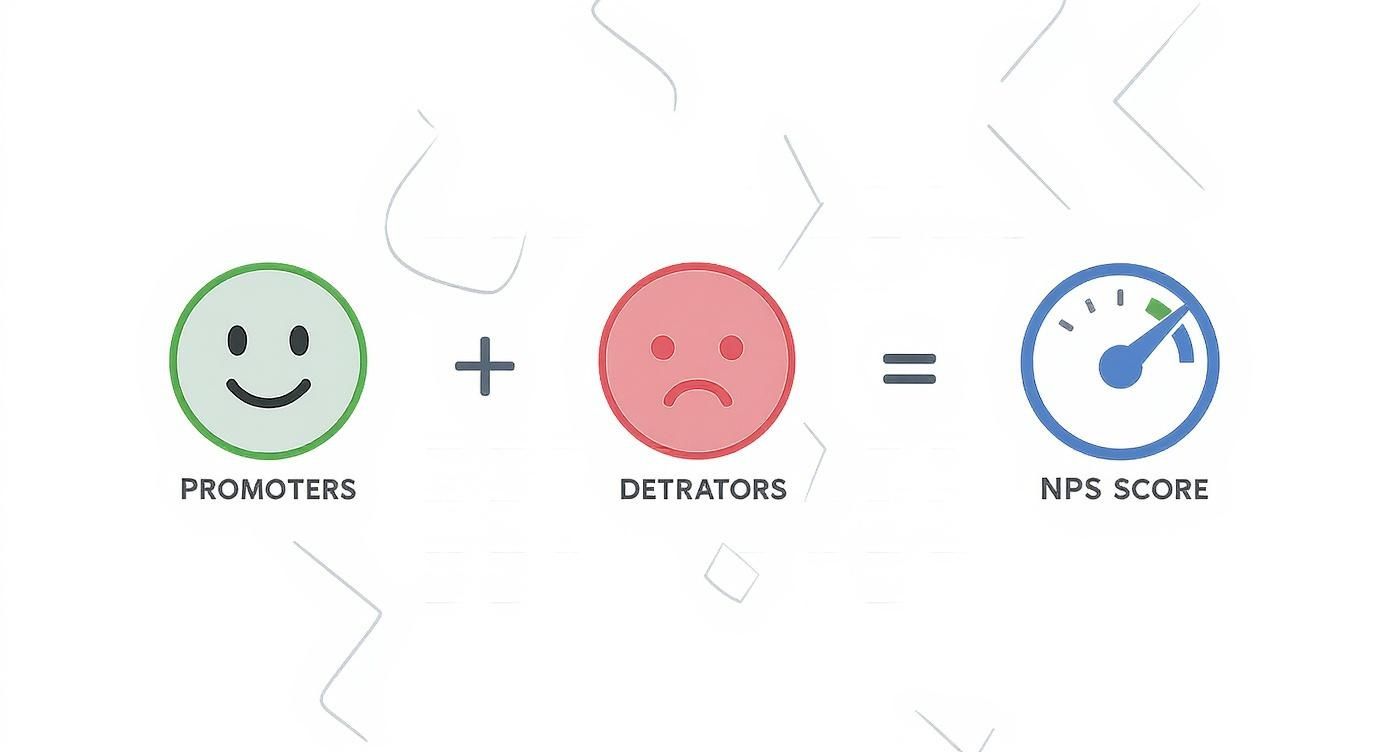
It’s a battle between your biggest fans and your harshest critics. That’s why it’s a powerful leading indicator of growth or churn.
The Only Benchmark That Matters: Your Industry
Your score's value comes from comparison. An NPS of 30 might feel mediocre, but if the industry average is 22, you're winning. Context is everything.
Look how wildly scores differ:
- Insurance often hits a stellar average of 80.
- Financial Services is close behind with a 75 average.
- Construction has dipped to an average of 34.
- Retail hovers around 50 as brands figure out personalization.
These benchmarks, all calculated with the same simple formula, are your reality check. You can get a deeper dive into these NPS findings to see where you fit.
Actionable Takeaway: Stop asking "What's a good score?" and start asking "What's my direct competitor's score?" Your goal isn't a number; it's to crush the companies your customers could leave you for.
Don't Let Cultural Bias Wreck Your Data
If you’re a global company, your NPS data can get messy fast. Cultural norms dictate how people answer surveys.
A score of "8" in Japan might be the cultural equivalent of a "10" in the US. Some cultures avoid extreme enthusiasm; others embrace it.
- The "Polite" 7: In some regions, a 7 or 8 is a huge compliment. But the NPS formula mercilessly dumps them in the "Passive" bucket.
- Direct vs. Indirect Feedback: Some cultures are blunt with criticism, tanking your score over minor issues.
This doesn't mean the metric is broken. It means you can't compare your German score to your American one. I saw this with a global brand whose NPS in Japan was 20 points behind their US score. The qualitative feedback showed Japanese customers were just as loyal, but culturally less likely to give a perfect 10. They learned to benchmark each region against itself over time.
Actionable Takeaway: Segment your NPS by region. Comparing your score in Japan to your score in Brazil is comparing apples to angry oranges.
Common Mistakes That Make Your NPS Useless
The math is easy. Making sure the number means something is hard. Garbage in, garbage out. Get the process wrong, and you're celebrating a vanity score while your business is burning down.
I've seen founders fall into the same traps, corrupting their own data. Don't be one of them.
Biased Survey Timing
When you ask is as critical as what you ask. Only polling customers at their happiest moment is just asking for a pat on the back.
Classic timing mistakes:
- Post-Onboarding: Asking right after they’ve successfully set up. Of course they’re happy.
- After a Great Support Call: This measures support satisfaction, not brand loyalty.
- Immediately After Purchase: This captures transaction satisfaction, not long-term sentiment.
This isn't just about your customer journey. Culture matters. Brazil has an average NPS of 62, while Japan sits at -52, due to cultural norms around rating scales. This is a stark reminder to get your own timing consistent. You can explore more global NPS benchmarks to see how deep these differences go.
The Curse of Survey Fatigue
Hitting every customer with a survey after every interaction is the fastest way to annoy them and get trash responses.
When survey fatigue kicks in:
- Response rates plummet. Your happy, silent majority stops replying.
- Only the angriest users respond. Your survey becomes a lightning rod for Detractors, cratering your score.
Real-World Example: A SaaS company triggered an NPS survey after every closed support ticket. Their score was a dismal -15. We switched them to a quarterly "relationship" survey. Their score jumped to +30. The product didn't improve overnight; they just stopped annoying their best customers.
Listening Only to the Loudest Voices
Giving equal weight to all feedback is a fatal error. Your most vocal customers—the die-hard fans and the perpetually angry—are outliers. Building your strategy around them means building for the extremes, not your core user base.
The real gold is hidden with your Passives. They’re content enough not to leave, but not excited enough to recommend you. Figuring out what it takes to convert them is where real growth happens.
Actionable Takeaway: Stop letting your NPS become a vanity metric. Set a strict, repeatable survey cadence—like 30 days post-purchase or quarterly—to ensure your score reflects reality, not a biased snapshot.
Turning Your NPS Score into Action
You used an NPS formula calculator. You have your score. It’s 20. That tells you what is happening. It tells you nothing about why.
The number is just the headline. The real story is buried in the open-ended comments. Ignoring the text is like reading a scoreboard without watching the game.

Think of your score as a vital sign. A sudden drop means there's a problem, but you still have to diagnose the illness. The diagnosis is in the verbatim feedback.
Beyond the Score: A Real-World Example
A SaaS company was stuck at an NPS of 20. The leadership team was baffled. The number gave them nothing.
It wasn't until they dug into the comments that a pattern emerged. Dozens of Detractors and Passives said the same thing: they loved the core feature, but sluggish performance during peak hours was a deal-breaker. This critical flaw was hiding in plain sight, completely invisible to the score alone.
Actionable Takeaway: Your NPS score is the smoke alarm. The customer comments are the fire. You need both. Don't just calculate your score; commit to reading and acting on the feedback.
Your First Line of Defense: Your Own Team
The NPS framework isn't just for customers. Turn it inward with the Employee Net Promoter Score (eNPS). Happy employees create happy customers. An unhappy team is a leading indicator for CX disasters.
The global average eNPS jumped 52% from 2021 to 2022. The data shows companies with higher eNPS see 21% greater profits and 17% higher productivity. It's not a "nice-to-have" metric; it's a bottom-line driver.
From Insight to Improvement
Once you know the "why," get to work. Implementing solid customer onboarding best practices is a great place to start. Fixing problems for Detractors is about survival. But converting Passives into Promoters is about growth. Our guide on how to improve NPS scores provides a battle-tested plan for turning feedback into results.
Frequently Asked Questions About the NPS Formula
What's a "good" NPS score, really?
It depends entirely on your industry. A +20 is great for an airline but terrible for a SaaS company. Focus on two things: beating your direct competitors and improving your own score over time. A rising trend from 15 to 25 is more valuable than a stagnant 30.
Can I calculate NPS with only a few responses?
You can, but the score will be extremely volatile. With fewer than 50 responses, one new Detractor can tank your score and cause a panic. Focus on the qualitative comments from those few respondents; they're more valuable than the unstable number.
What's the difference between transactional and relational NPS?
Relational NPS is a periodic health check (e.g., quarterly) to measure overall brand loyalty. Transactional NPS is triggered by a specific event (e.g., after a support call) to measure performance at a single touchpoint. You need both: relational for long-term strategy, transactional to fix immediate friction points.
How do I handle incomplete or spam survey responses?
If someone leaves a score but no comment, accept the number and move on. If a response is clearly spam or gibberish, throw it out. Don't let bad data pollute your results. The goal is a clear signal, not a bigger sample size.
If you’ve got more than 20 open-ended responses, stop suffering—Backsy.ai scores them in minutes.
