Your shortest path to a useful insight
Start with a few comments you already have. You don’t need a survey, an integration, or a list of attributes.
- Create your product. Give it a name. A sentence about what it does makes the analysis more useful.
- Add two or three customer responses. Open Collect feedback → Paste existing feedback. Separate responses with a blank line, then add them.
- Choose Analyze feedback. Review the credit cost, then run your first report.
- Read the first theme and its evidence. Open a theme, check the original words, and choose one action to test.
Start small. Your first 3 credits are enough to analyze 3 responses. One response can be useful, but a pattern becomes more convincing when more customers describe it.
Give your product a home
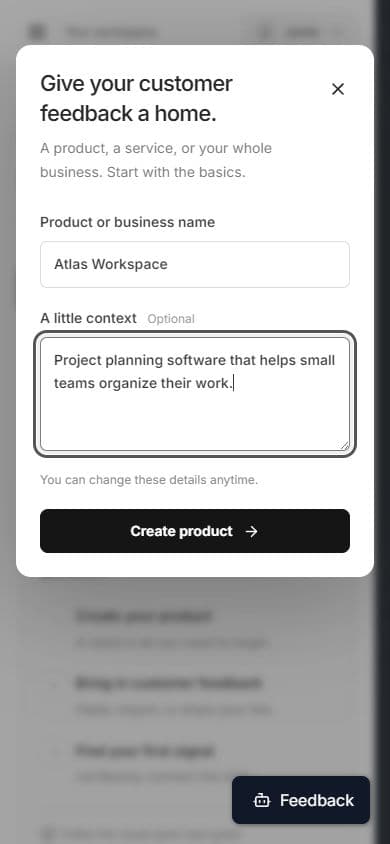
From Overview, choose New product. Enter a product, service, or business name. The description is optional; use it to explain who you help and what you offer.
Your public feedback link is created immediately. Product creation is free and doesn’t use analysis credits. You can change the name, description, and image later in Product settings.
No analysis setup required. Themes are discovered from customer feedback. Focus areas are optional and can wait until you know what you want to track.
Start a conversation—or bring one with you
Open your product’s Collect feedback tab and choose a starting point.
Paste feedback
Paste up to 50 responses. Use blank lines to separate longer comments, or choose “Each line” if every line is a different response. Check the detected count before adding.
Share a link
Copy the public feedback link, download its QR code, or embed the form on your site. Customers can submit text or voice without creating an account.
Import a file
Upload CSV, XLSX, JSON, or JSONL. Use a feedback or text column for instant detection. A date column is optional. Files can contain up to 10,000 rows and be up to 5 MB.
Empty and duplicate entries are skipped. Each response can contain up to 30,000 characters. Download the sample CSV and replace the example rows with your own customer comments.
Ask for the moment, not just a rating.
- “What almost stopped you from choosing us?”
- “Where did you get stuck today?”
- “What would you miss if this product disappeared?”
- “What’s one thing we could make easier?”
In Customize feedback form, you can edit the title, description, branding, thank-you message, and availability. Your existing links and widget code continue to work.
Validation and rewards
Paid plans include feedback validation and filtering. Configure your criteria in the form editor. If you use rewards, keep the offer clear and avoid requiring positive feedback to qualify.
Your public showcase
Existing showcase pages and attribute scores are preserved. If your showcase is enabled, open it from Product settings → Collection & presentation.
Read the signal. Check the evidence.
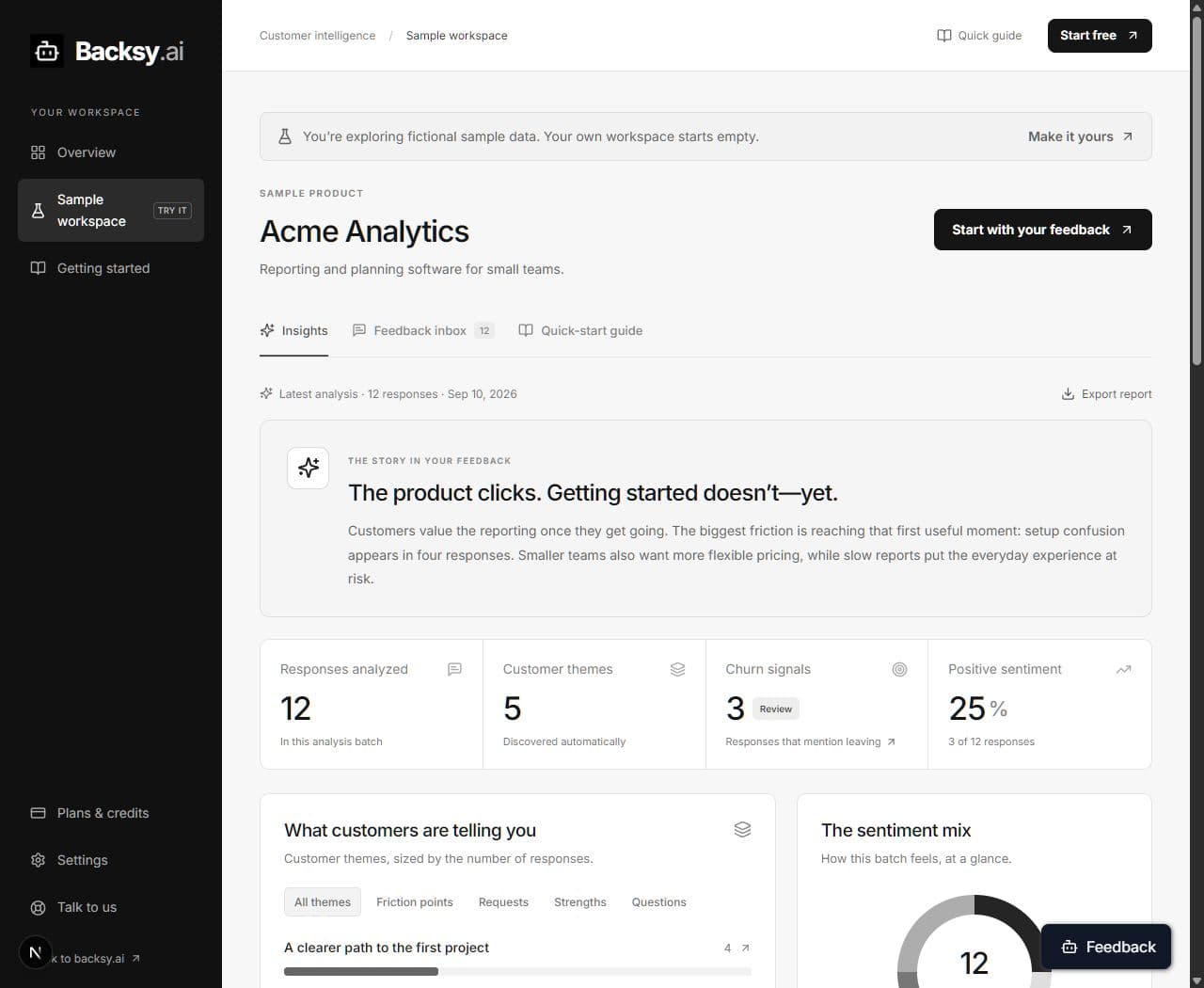
Choose Analyze feedback when there are new responses. You’ll see the exact credit cost before starting. Backsy analyzes up to 50 responses per batch, bounded by response length and available credits. Remaining responses stay ready for your next run.
The report shows the latest analyzed batch. Workspace totals include all responses. Keeping those separate helps you understand what each result actually describes.
A short summary of what stands out in this batch.
Friction, requests, strengths, and questions. Click any theme to read its source quotes. One response can belong to several themes, so counts may overlap.
Positive, neutral, negative, or mixed sentiment, plus where the feedback fits in the customer journey.
Responses explicitly mentioning leaving, canceling, not renewing, or switching. This is stated intent to investigate, not a churn rate or customer prediction.
Practical actions linked to customer evidence. Impact and effort are AI estimates; validate them with your team.
See positive sentiment share across your recent reports. Different sample sizes and customer groups can affect the comparison.
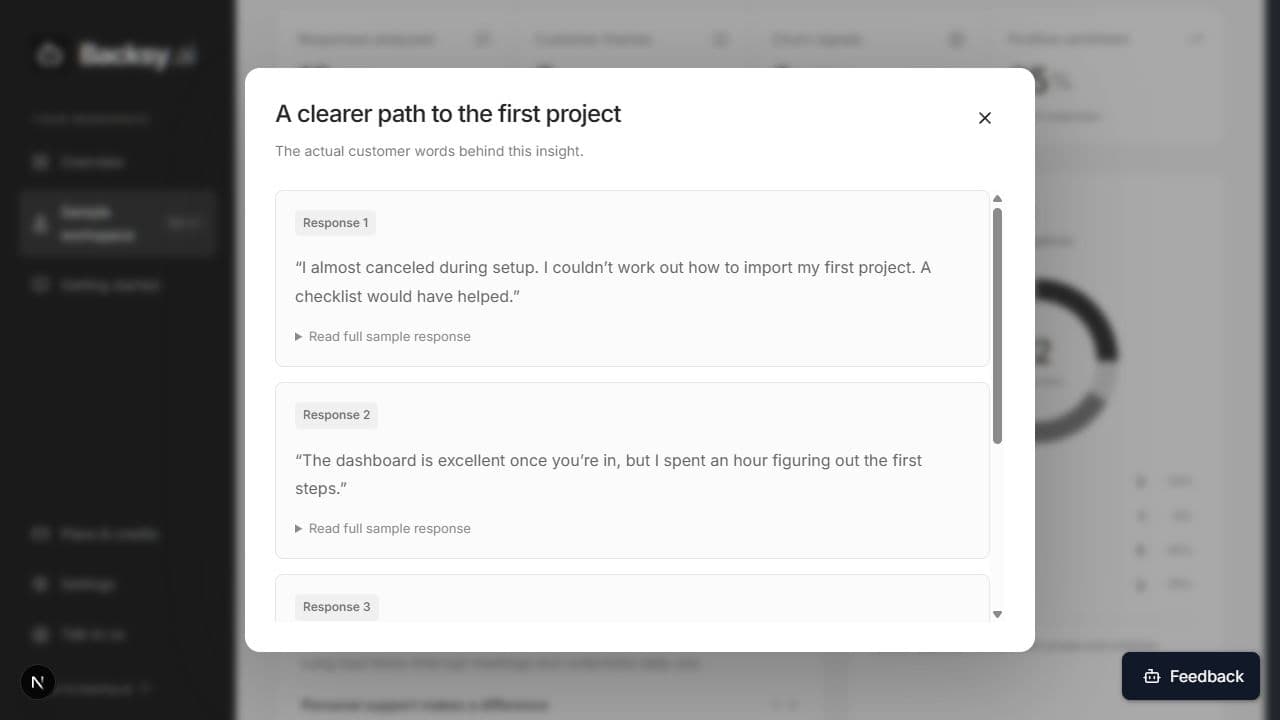
Make one useful change. Choose a priority, read the evidence, and test a small improvement. Then collect another batch to see what customers say. Use Export report for a Markdown copy to discuss with your team.
Focus areas, when you need them
Focus areas are the optional feature previously called attributes. Find them in Product settings. Existing names, scores, and history remain available.
Use a focus area when you want to track a particular aspect, such as “Ease of getting started” or “Quality of support.” Backsy scores it from 0 to 100 only when new feedback provides evidence. A higher score represents more positive sentiment in the analyzed batch; it is not an NPS or customer satisfaction survey score.
Adding or editing a focus area does not reset or re-charge past feedback. It applies to future analysis. Automatic themes still surface other things customers care about.
A few things you might be wondering
My product has no attributes. Can I still analyze it?
Yes. Add feedback and choose Analyze feedback. Backsy automatically discovers themes and suggests priorities.
Why is Analyze feedback disabled?
You need at least one new response and one credit. The button also stays disabled while an analysis is already running. Your existing report remains available.
I imported more responses than the report includes.
Each report covers a bounded batch of up to 50 new responses. Very long responses or a smaller credit balance can reduce the batch size. Remaining feedback stays in the inbox for the next analysis.
My import didn’t find the feedback column.
Rename the column containing customer comments to feedback or text. Keep one response per row. Check the file is under 5 MB and includes no more than 10,000 rows.
My public feedback form isn’t accepting responses.
Open Customize feedback form and check that the form is active and its end date has not passed. Review validation criteria if legitimate responses are rejected.
Where did my old analysis go?
Your previous attribute scores are in Product settings under Focus areas. Your original feedback is still in the inbox. Add new responses to generate the richer report.
The AI report doesn’t match what I expected.
Open the source quotes and check the batch size. A small or unrepresentative sample can give an incomplete picture. Use AI findings as starting points for investigation.
Customer information
Only submit feedback you’re authorized to use. Avoid unnecessary personal or sensitive information in imports. Read our privacy policy for details about data handling.