Your Customers Are Screaming at You. Are You Even Listening?
Discover the sentiment analysis techniques that turn customer feedback into a competitive advantage. A practical, no-fluff guide for founders.
Posted by
 Backsy
Related reading
Why Reputation Management Tools Matter More in 2025 Than Ever
Learn how reputation management tools help businesses track reviews, analyze feedback, and protect brand image. A modern guide with AI-driven insights using Backsy.
Sentiment Analysis Isn’t a “Nice-to-Have”. It’s a Lie Detector for Your Product.
Founders love chasing features, but customers speak in emotions. Learn what sentiment analysis really is, how it works, and how it reveals the truth behind your feedback. No fluff.
Customer Feedback Analysis: A No-BS Playbook for SaaS Founders
Stop guessing. This blunt guide to customer feedback analysis shows SaaS founders how to turn raw comments into roadmap decisions, retention wins, and revenue.
You’re sitting on a mountain of raw customer feedback—support tickets, app store reviews, angry tweets—and you're treating it like a landfill. That’s not a missed opportunity; it’s a slow-motion car crash. Every single piece of that feedback is a flare, a signal pointing to what’s broken or what’s brilliant. Ignore your customers, and you’ll be lucky to survive the quarter.
This isn’t about some vague, feel-good "listening to customers" bullshit. This is about building a machine that translates raw, messy human language into a roadmap you can execute on. Systematically analyzing customer sentiment is how you pinpoint what makes people leave (how to reduce customer churn) and what makes them stay. It’s the difference between guessing and knowing.
Stop Trusting Your Gut. It's Probably Wrong.
Too many founders are high on their own supply. We build what we think is cool and convince ourselves we know what's best. But the startup graveyard is littered with beautiful products nobody wanted. Your gut is a liar. Your customer feedback is a treasure map to product-market fit.
We’re going to break down the actual sentiment analysis techniques that separate companies that scale from the ones that stall. You don’t need a Ph.D. in data science, but you do need to stop treating this data like trash. For a deeper dive on this, read our guide on customer feedback insights. It's required reading.
You wouldn't ignore a fire alarm in your server room. So why are you ignoring the alarms your customers are sounding every single day?
The goal is simple: stop letting the one angry email that ruined your morning dictate your product roadmap. It’s time to find the real patterns hidden in thousands of comments.
Takeaway: Stop admiring the problem and start building a machine that turns customer noise into product signal.
Level 1: Lexicons — The Fast, Dirty, and Dumb Method
Alright, first up is the lexicon-based method. Think of it as the brute-force approach. It’s a glorified word counter with an opinion. It works by smashing text against a pre-built dictionary where each word has a score: ‘love’ = +1, ‘hate’ = -1. The algorithm zips through your feedback, adds up the scores, and spits out a number. Positive, negative, or neutral. Done.
Why You’d Bother With This
Speed. Simplicity. It's the cheapest and fastest way to get a directional signal from a mountain of text. No complex models, no data science team, no training servers. You could duct-tape a basic version together in an afternoon.
If you're sifting through a million reviews and just need to know if the vibe is ‘on fire’ or ‘mostly fine,’ the lexicon method is your blunt instrument of choice. It’s a thermometer, not an MRI.
It’s perfect for a quick pulse check. Just launched a feature? Feed all the new tickets and tweets into the machine. If the sentiment score suddenly craters, you know you have a fire to put out, even if you don’t know where the smoke is coming from.
Where It Completely Face-Plants
This method is dumber than a bag of hammers. It has zero concept of context, nuance, or sarcasm. It's a dictionary, not a brain.
See this feedback? “I just love how my phone battery now dies in two hours. Truly incredible work.”
A lexicon model sees "love" and "incredible" and flags it as glowing praise. It also chokes on simple negation. "Not good" might even register as slightly positive because it latches onto "good" and ignores the "not." Industry jargon? Forget it.
Relying on this for any high-stakes decision is like navigating a minefield with a pogo stick. You might get lucky, but a messy end is guaranteed.
Takeaway: Use lexicons for a fast, cheap pulse check, but never trust them with a decision that actually matters.
Level 2: Machine Learning — Your First Real Weapon
A lexicon is a hammer. Machine learning is a scalpel. This is where you stop just counting words and start teaching a machine to recognize your customers' patterns. Instead of a generic dictionary, you train a model like Naive Bayes or Support Vector Machine (SVM) on your own data. You’re the coach, your feedback is the training field.
Training Your Own Sentiment Detective
It’s a grind. You take a few thousand pieces of customer feedback and manually label them: positive, negative, neutral. Then you feed them to the model. The machine learns the statistical probability that certain words correlate with a specific sentiment in your business context.
This is a massive leap. It can learn that "slow" in a software review is a bug report, but "slow-cooked" in a restaurant review is a compliment. Context is finally in the game.
This isn't just a better method; it's a different class of analysis. It’s the difference between giving someone a map and teaching them how to read the terrain.
Your accuracy skyrockets because the model is tuned to your customers' unique slang and pain points. For the mechanics, get familiar with the basics of natural language processing for business; our guide breaks it down without the academic fluff.
The Hidden Costs of Getting Smarter
This isn't magic. These models are hungry for one thing: labeled data. A few hundred examples won't cut it. You need thousands, which means someone on your team is spending hours reading and tagging feedback. There's no shortcut.
And no, this isn't a no-code drag-and-drop thing. You need someone who can write Python and use a library like scikit-learn. It's a real commitment of time and talent. This need is why the sentiment analytics market is set to explode from USD 5.1 billion to USD 11.4 billion by 2030. Companies are waking up. You can read the full market growth research here.
Even then, these models still get confused by sarcasm and complex sentences. They’re smart, but they’re not street-smart.
Takeaway: Machine learning is your first step to real accuracy, but be prepared to pay the iron price in labeled data and engineering time.
Level 3: Transformers — Bringing in the SEAL Team
If lexicons are a hammer and ML is a scalpel, transformer models are a full-on neurosurgery suite. We’re talking BERT and GPT. These models don’t just read the dictionary; they’ve read the entire internet.
They come pre-trained on a staggering amount of text, giving them a deep "feel" for language. Your job isn't to teach them English from scratch; it’s to fine-tune them on your customer feedback so they can learn your specific dialect.
From Keywords to Actual Understanding
The payoff? A model that can finally handle the beautiful mess of human language. It deciphers complex thoughts like, "I wouldn't say it was the worst experience, but it was far from the best." It spots sarcasm that would fly over a lesser model’s head. This isn't just about a more accurate score; it's about grasping the flavor of a customer's frustration. Check out ChatGPT's role in brand monitoring for e-commerce to see this tech in the wild.
The old models read your customer feedback. Transformers understand it. There's a universe of difference there, and that’s where your competitive advantage lies.
This is the tech fueling the market’s explosive growth, forecasted to jump from USD 2.6 billion in 2022 to over USD 10.6 billion by 2025. Why? Because decoding genuine customer emotion is the key to everything.
This decision tree cuts through the crap.
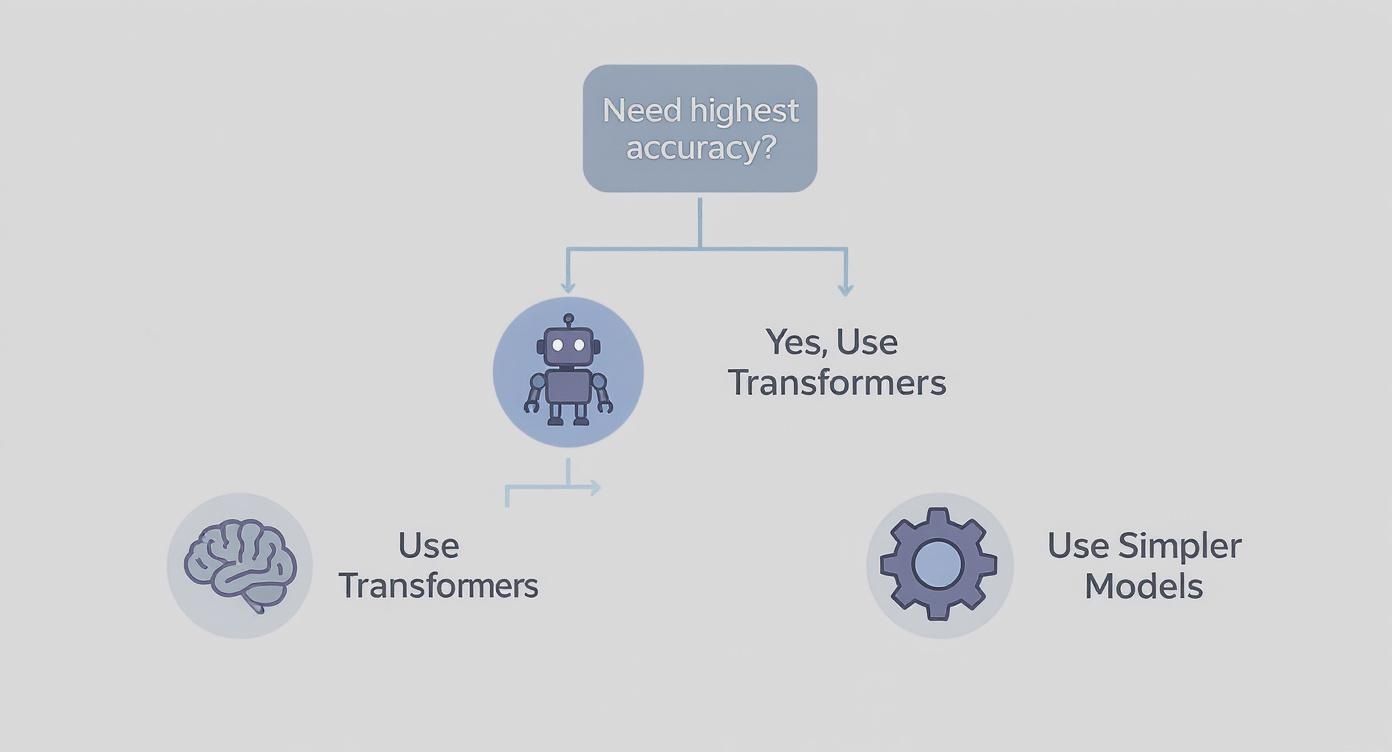
If pinpoint accuracy is non-negotiable, transformers are the only game in town.
The Heavy Price of Power
This level of sophistication will make your CFO sweat. Transformer models are computationally hungry beasts. We're talking high-end GPUs or a cloud bill that looks like a phone number.
- Financial Cost: Your cloud provider will send you a holiday card. This is a significant, ongoing operational expense.
- Technical Debt: You need engineers who live and breathe PyTorch or TensorFlow. This isn’t a junior dev’s weekend project.
- Data Requirement: "Garbage in, garbage out" still applies. It just costs you a lot more for every piece of garbage you feed it.
Don't be the founder who gets star-struck by the tech and bankrupts the company on a model you don't need yet. This is a strategic investment you make only when the cost of misunderstanding your customers is greater than the cost of the AI.
Choosing Your Weapon
Here’s a no-BS comparison. Your choice depends on your budget, timeline, and how much you hate being wrong.
| Technique | Best For | Biggest Weakness | Founder Metaphor |
|---|---|---|---|
| Lexicon-Based | A quick and dirty "vibe check" when you have no money. | Nuance? Sarcasm? Context? lol, no. | The scrappy bootstrapper building an MVP on a shoestring. |
| Classical ML | When you need decent accuracy and have some clean data to grind. | Demands thousands of labeled examples; chokes on tricky language. | The Series A founder who needs a real metric for the board deck. |
| Transformers | When accuracy is everything and you need to know why. | The cost. Oh, the cost. In both cash and engineering headaches. | The well-funded scale-up aiming for market domination. |
The "best" model is the one that solves your problem without sinking your ship. Start simple.
The Only Thing That Matters: Aspect-Based Sentiment Analysis
Let’s be real. Knowing a review is ‘negative’ is useless. It’s a vanity metric that makes you feel like you have insight when you have nothing. Why is it negative? What specific part of your product is driving customers insane? Answering that is the only thing that matters.
This is where Aspect-Based Sentiment Analysis (ABSA) changes the entire game. Forget blanket positive/negative scores. ABSA tells you what features customers are talking about and how they feel about each one.
From Vague Noise to an Actionable Hit List
Take this review: "The battery life is incredible, but the camera is a grainy, unusable mess."
A basic tool sees "incredible" and "mess" and averages it to a useless ‘neutral’ score. You learned nothing.
ABSA dissects it with surgical precision:
- Aspect: Battery Life → Sentiment: Positive
- Aspect: Camera Quality → Sentiment: Negative
Suddenly, you have a mission. You know exactly what to tell your product team to fix and your marketing team to highlight. This is how you turn a chaotic mess of feedback into a prioritized product roadmap. It’s how you stop guessing. Our guide on Voice of Customer analysis shows how to turn these signals into strategy.
Stop asking, ‘Are they happy?’ and start asking, ‘What are they happy about?’ The first question leads to meetings. The second leads to a better product.
The Hybrid Engine for Growth
Implementing ABSA is more complex. It usually requires a hybrid approach, maybe using a machine learning model to identify aspects ("battery," "UI") and a transformer to nail the sentiment for each.
It’s an investment, but the return is stopping you from pouring engineering resources into features nobody cares about and instead fixing the weaknesses that are costing you customers. This level of detail is non-negotiable in competitive markets.
The demand for this insight is why the sentiment analytics market is projected to skyrocket from USD 4.64 billion in 2025 to over USD 16 billion by 2035. Retail is expected to claim a 55.6% slice of that pie because they live or die by this stuff. You can find more data on the sentiment analytics market at Research Nester.
While your rivals are staring at a meaningless "72% positive" dashboard, you'll be fixing the three bugs driving customers away.
Garbage In, Garbage Out: Where Your Fancy AI Goes to Die
So you bought the state-of-the-art AI model. Congratulations. Now for the hard part. Your model is only as good as the data you feed it.
Ignoring data preprocessing is like building a skyscraper on a swamp. It doesn't matter how brilliant the architecture is; the whole thing is doomed.
The Monsters Lurking in Your Data
Don't be the founder who spends a fortune on a model only to feed it raw internet garbage. Here’s what will tank your accuracy:
- Sarcasm & Irony: When a customer writes, “Great, another bug,” your model sees "Great" and files it under "positive." It's an idiot.
- Complex Negation: “I can’t say I was particularly impressed,” is clearly negative. To a basic model, it’s a confusing mess.
- Typos, Slang, & Emojis: Your data is filled with "smh," "lol," and "fire 🔥." Your model has to learn this dialect, or it will fail.
The brutal reality is that 80% of the work in any AI project is cleaning data. The other 20% is the fun part with models. Get that ratio wrong, and you’re just building a very expensive random number generator.
Why Context Is Your God
Even perfect words are misleading without context. If you sell medical equipment, a review calling your scanner "sick" is high praise. If you sell restaurant software, it's a one-star review. Your model won't know the difference unless you teach it.
The same goes for jargon. Every business has its own language. You have to define what ‘latency,’ ‘churn,’ or ‘stickiness’ mean and whether they’re good or bad. Skip this, and your analysis will be useless.
Stop Guessing. Start Building.
You've seen the playbook, from the cheap hammer to the expensive SEAL team. The methods are out there. The tools are accessible. The only thing holding you back is the comfort of guessing.
Manually reading feedback—or worse, not reading it at all—is navigating a storm without a compass. Your competitors are already building dashboards lit up with customer insights. Flying blind isn't a strategy; it's a choice.
You don't need a flawless system on day one. You just need a better one than you had yesterday. Chasing perfection is a fancy word for procrastination.
So, where do you start? Pick an approach. Start small. A simple lexicon model is better than the nothing you have now. The insights are already in your data, waiting. Every day you wait is another day your competition gets closer to your customers.
Stop building what you think customers want and let Backsy show you what they're screaming for.
