Customer Advisory Board: The Founder's Playbook for Avoiding Catastrophic Mistakes
A practical guide to building a customer advisory board that provides honest insights, validates your strategy, and prevents costly product mistakes.
Posted by
 Backsy
Related reading
Transforming Customer Feedback Analysis with AI in Real-Time
Discover how AI revolutionizes customer feedback collection and analysis, enabling swift, informed decision-making for businesses.
10 Voice of Customer Examples You Can Actually Use
Stop guessing. See 10 real voice of customer examples from surveys, social media, and support tickets to find out what your customers actually want.
A Founder's Guide to Analyzing Survey Data
A battle-tested approach to analyzing survey data. Learn how to turn raw feedback into actionable insights that drive real business decisions.
Here’s the TL;DR in 20 seconds. A Customer Advisory Board (CAB) is not a focus group or a complaint line. It’s a strategic council of your best customers, recruited to pressure-test your roadmap and stop you from building beautiful products nobody needs.
- Goal: Get brutally honest, forward-looking advice, not validation.
- Recruit: Target constructive critics, not your happiest fans.
- Agenda: Run it like a strategic workshop, not a sales pitch.
- Follow-Up: Close the loop with a "You Said, We Did" report to prove you listened.
- ROI: Track member retention and expansion revenue to prove its value.
What Is a Customer Advisory Board?
For any founder serious about winning, a customer advisory board (CAB) isn't a "nice-to-have"—it's a survival mechanism. A CAB is a formal group of your top customers who meet regularly to give you unfiltered advice on your company's direction. It’s the difference between guessing what the market wants and actually knowing.
This is where you kill your bad ideas before they cost you millions. It’s how you move beyond generic surveys and into strategic conversations that prevent you from building things nobody will pay for.

The point isn’t to get a pat on the back. It's to pressure-test your strategy against market reality. Your board becomes an early warning system for industry shifts and a direct line into the real-world problems your customers face daily.
CAB vs. Focus Group: Don't Confuse Strategy with Tactics
It's a rookie mistake to mix up a CAB with a focus group. A focus group is tactical and short-term. A CAB is strategic and long-term. One gives you a snapshot; the other gives you the map.
Here’s the difference in plain English.
| Attribute | Customer Advisory Board (Strategic) | Focus Group (Tactical) |
|---|---|---|
| Purpose | High-level strategic guidance on roadmap & market direction. | Feedback on a specific feature, campaign, or product. |
| Participants | Senior executives & strategic decision-makers. | End-users or specific customer segments. |
| Duration | Ongoing relationship (12-24 months). | One-time session (1-2 hours). |
| Outcome | Long-term company and product strategy. | Immediate, actionable feedback for a single project. |
Simply put: you run a focus group to tweak a feature. You build a CAB to define the future of your company.
A CAB formalizes the act of listening. It turns random customer chats into a structured customer feedback loop that serves as your best defense against internal bias and dangerous market blind spots.
Actionable Takeaway: Stop treating customer feedback as a reactive task. Formalize it with a CAB to get ahead of market shifts and build what your best customers will actually pay for.
Why Do You Need a Customer Advisory Board?
Most startups navigate by looking in the rearview mirror—obsessing over lagging indicators like MRR and churn. By the time those numbers flash red, the damage is done. You’re left reacting to problems that took root months ago.
A customer advisory board is your forward-looking radar. It’s the guide who spots the treacherous currents ahead before your ship starts taking on water. Instead of waiting for customers to churn to find out why, a CAB gives you a direct, honest line to your most important partners. It lets you see around corners and anticipate where the market is going, not just where it's been.
Your Product Team’s Secret Weapon
Your product team is brilliant, but they aren’t your customer. They’re so deep in the weeds of your solution that blind spots are inevitable. A well-run CAB is a powerful extension of your team, providing the raw insights that stop you from making catastrophic roadmap mistakes.
This isn't about feature requests. This is about deep, strategic conversations focused on the real-world pains and shifting priorities of your market. A CAB helps your team answer the big questions:
- Is the problem we're solving still the most urgent one?
- What outside pressures are squeezing our customers? (New regulations, competitive moves, macro shifts).
- Where is the industry actually going in the next 18-24 months?
This guidance stops you from sinking engineering resources into features nobody asked for and keeps your team focused on creating real value. A CAB isn't a focus group to validate your ideas. It's a strategic council you build to challenge them.
Real-World Example: The Million-Dollar Meeting That Saved a Company
I worked with a B2B SaaS company that poured over $1.5 million and nine months into a new analytics module. Internally, everyone was convinced it was a game-changer. Two weeks before launch, they presented it to their new customer advisory board.
The feedback was brutal.
The board members, all senior leaders, politely explained that while the analytics were "nice," they didn't solve a pressing business problem. Worse, a competitor had just rolled out a "good enough" version for free. Their expensive module was dead on arrival.
Based on that single two-hour meeting, the company pulled the launch. They pivoted their strategy to tackle a compliance issue the CAB had flagged instead. That pivot not only saved them from a colossal failure but led to their most successful product release ever, driving a 40% jump in enterprise deals within six months. The CAB didn't just offer feedback; it saved the business.
Actionable Takeaway: Your internal assumptions are your single biggest risk. Think of a customer advisory board as the best insurance policy you can buy against your own biases.
Recruiting Your A-Team, Not Your Yes-Men
The biggest mistake founders make with a customer advisory board is stacking it with their happiest, most agreeable customers. It feels great. Your ego gets a nice massage. But it’s a complete waste of time.
A CAB built on validation is doomed. You're not looking for cheerleaders. You’re hunting for constructive critics, sharp strategic thinkers, and industry visionaries who have the guts to tell you your brilliant idea is garbage.
The value of your board is directly proportional to the honesty in the room. Recruiting fans gets you a fan club; recruiting experts gets you a real strategy.
Defining Your Ideal Board Member Profile
Before sending a single email, create a crystal-clear profile of who you're looking for. This isn't about collecting logos for your website. It's about identifying the expertise that will give you the most strategic insight.
- Strategic Thinker: Do they focus on the "why," not just the "what"? Look for people who talk about market trends and competitive pressures.
- Constructive Dissenter: You need someone comfortable disagreeing with the consensus. Do they present contrarian, well-reasoned viewpoints in public forums?
- Industry Visionary: This person isn't just using your product; they are shaping their industry's future. They see what's coming and can help you get there first.
- Power User: They know your product inside and out—the good, the bad, and the ugly. Their practical knowledge keeps strategic conversations grounded in reality.
Avoid recruiting anyone whose main motivation is networking or adding a title to their resume. You want people genuinely invested in solving the core problem your product addresses.
Crafting an Irresistible Invitation
Your invitation needs to land like an exclusive opportunity, not another request for a favor. Generic emails are a ticket to the trash folder. Your outreach must be personal, strategic, and focused on mutual value.
- Why Them, Specifically: Reference an insight they shared in a blog post, a talk they gave, or a smart comment they made. Show you’ve done your homework.
- The Strategic Mission: Frame the CAB as a "strategic partnership to shape the future of [Your Industry]." Avoid language that makes it sound like a simple feedback session.
- The WIIFM (What's In It For Me): Clearly spell out the value for them—exclusive access to your exec team, powerful peer networking, and a real chance to influence a tool they rely on.
Real-World Example: A fintech company recruited a C-level bank executive by referencing a specific point he made on a podcast about compliance challenges. The CEO framed the CAB as a chance to build the exact solution the executive had described. The exec accepted in 24 hours because the invitation spoke directly to his biggest professional headache.
Actionable Takeaway: Recruit for candid debate, not for comfort. Your ideal customer advisory board member is someone who respects you enough to disagree with you.
Designing Meetings That Deliver Real Insights
A bad meeting doesn’t just kill momentum; it disrespects your best customers’ time. A high-impact customer advisory board meeting is a strategic workshop, not a sales pitch. If you run it like one, you’ll lose your members’ trust—fast.
The goal isn't to talk at them. It’s to create an environment where they can debate, challenge, and build with you. The structure of your agenda is everything. You need a deliberate flow that guides the conversation from broad market trends down to the specific strategic dilemmas keeping you up at night.
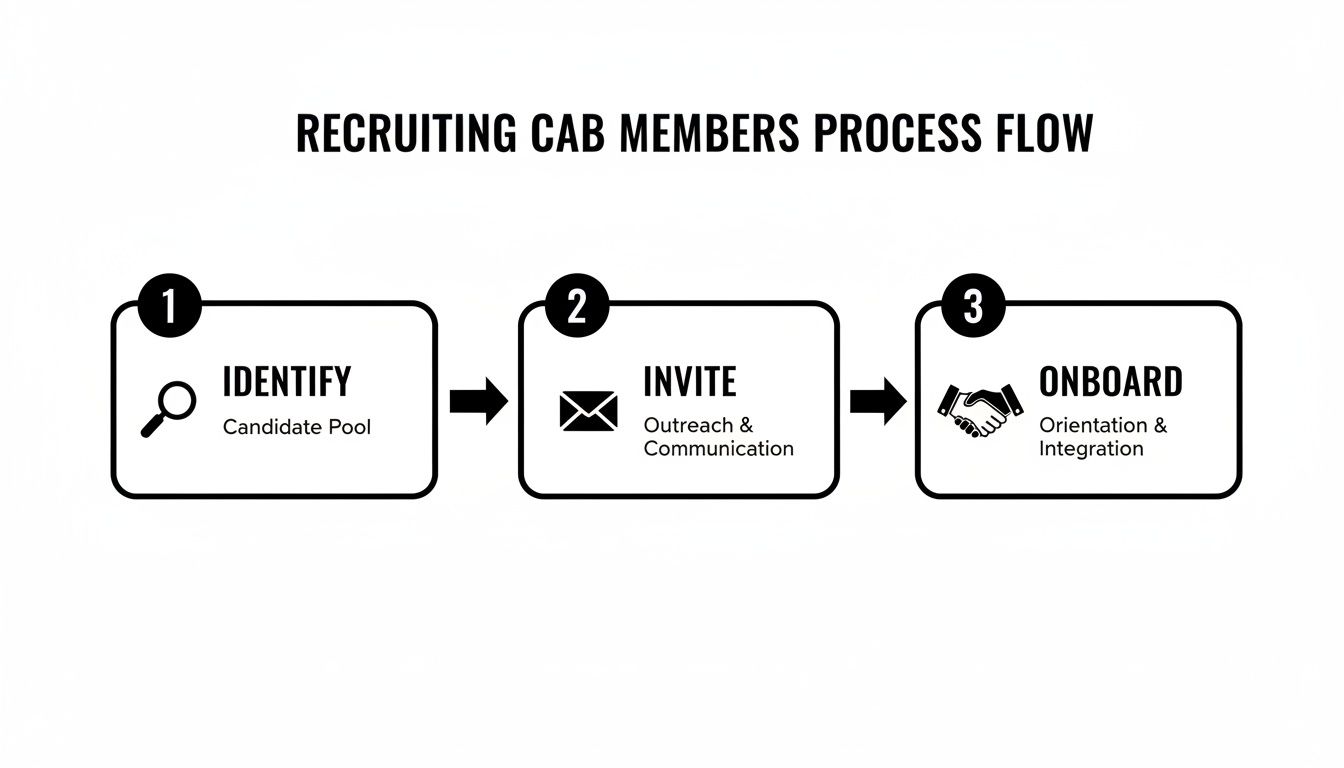
This process is simple but critical. Identify the right strategic thinkers. Craft a compelling invitation focused on the value for them. Onboard them smoothly. This structured approach attracts and retains high-caliber members who provide real strategic value.
The Anatomy of a High-Impact Agenda
Your agenda is the battle plan. Every minute should be accounted for, with a clear objective for each session. Avoid vague topics like "Roadmap Discussion." Instead, frame it as a challenge: "Debate: Where Should We Place Our Biggest Bets in 2025?"
Here's a sample agenda structure for a four-hour session. Steal it.
| Time Slot | Activity | Objective |
|---|---|---|
| 0:00 - 0:15 | Welcome & Strategic Kickoff | Set the tone, state the meeting's core strategic question. |
| 0:15 - 0:45 | "State of the Union" Business Update | Briefly share key business metrics and progress. |
| 0:45 - 1:45 | Interactive Session 1: Market Trends | Facilitate a debate on emerging market shifts or competitive threats. |
| 1:45 - 2:00 | Break | Allow for informal networking and a mental reset. |
| 2:00 - 3:00 | Interactive Session 2: "Pre-Mortem" | Present a future initiative and have the CAB brainstorm all the ways it could fail. |
| 3:00 - 3:45 | Open Forum & Strategic Advice | Give members the floor to raise topics or offer unsolicited, high-level advice. |
| 3:45 - 4:00 | Action Items & Closing Remarks | Summarize key takeaways, outline next steps, and confirm the value of their contributions. |
This agenda moves from context-setting to deep, interactive problem-solving, ensuring you walk away with concrete ideas.
Facilitation Is Not Optional
A brilliant agenda is useless without strong facilitation. The facilitator's job is to enforce structure, encourage healthy debate, and ensure no single voice dominates. For more tips on running effective sessions, check out these 8 Meeting Management Best Practices.
A skilled facilitator actively draws out quieter members ("Susan, you’ve dealt with this. What’s your take?") and politely cuts off tangents. Their role is to make the room safe for honest, tough feedback.
Real-World Example: A cybersecurity firm ran a "pre-mortem" on their planned European expansion. The board immediately flagged a critical flaw: the product’s data residency architecture was incompatible with GDPR in key markets. The US-based engineering team had completely overlooked this. That one-hour exercise saved the company from a costly, legally disastrous failure.
Actionable Takeaway: Stop running your CAB meetings like product demos. Design them as interactive workshops where your smartest customers can help you solve your hardest problems.
Turning High-Level Talk Into Actionable Strategy
The biggest risk with any advisory board is that it becomes a talk shop. If your best customers spend hours giving you strategic advice and see nothing happen, they’ll check out. Fast. The meeting isn't over when the call ends—that's when the real work begins.
From Messy Notes to Clear Mandates
Meeting transcripts are a mess. Your first job is to pan for gold. You need a system to turn hours of conversation into clear, actionable mandates for your teams. This isn’t about a to-do list; it’s about spotting the strategic themes.
- Capture Everything: Always record and transcribe the meeting.
- Identify Key Themes: Cluster related comments. What were the recurring pain points?
- Assign Ownership: Tag each actionable insight with a department (Product, Marketing, etc.).
- Prioritize Ruthlessly: Decide what to act on now, what to explore later, and what to politely decline.
For a deeper dive, our customer feedback analysis playbook offers a framework for making sense of this kind of unstructured input.
The Feedback Prioritization Framework
You can't act on every suggestion. If you try, you’ll end up with a Frankenstein product. You need a blunt framework for deciding what gets attention.
| Feedback Category | Description | Your Response |
|---|---|---|
| Implement Now | High-impact ideas that fit your current strategy and are technically doable. | Green-light it. Assign a team and a timeline. |
| Investigate Further | Interesting ideas that need more research or don't fit the current roadmap. | Park it in the "ideas backlog." Task a team to scope the ROI. |
| Acknowledge and Decline | Ideas that are out of scope, impossible, or contradict your vision. | Thank the member, but be direct and explain why you aren't pursuing it. |
Honesty is everything. It's better to tell a board member "no" and explain why than to say "that's a great idea" and do nothing. Silence is the ultimate engagement killer.
The "You Said, We Did" Report
This is the most crucial step. You have to communicate back to the board to prove their time was well spent. The most effective way is with a simple "You Said, We Did" report. Sent a few weeks after the meeting, it recaps key themes and details the specific actions your company is taking.
Real-World Example: A SaaS company’s CAB complained their onboarding process was a mess. Their report included:
You Said: "Your onboarding is too focused on features and not our business outcomes."
We Did: "We've kicked off a complete overhaul of our onboarding. The new flow will launch next quarter and will be role-based, focusing on achieving key goals in the first 30 days. We'd love for two of you to help us pilot it."
That simple paragraph turns vague feedback into concrete action and builds incredible goodwill. Tools like Backsy.ai can automate the analysis of meeting transcripts to quickly pinpoint these themes and build your report in minutes, not days.
Actionable Takeaway: Talk is cheap. Prove you're listening by creating and sharing a "You Said, We Did" report after every single meeting. It’s the best way to keep your most valuable customers engaged.
Measuring the Real ROI of Your CAB
It's one thing to talk about the "value" of your customer advisory board. It's another to prove it to your CFO. If you can't draw a straight line from your CAB to revenue or retention, you're treating it like a hobby—and hobbies get their budgets cut.
Let’s stop measuring success with fuzzy metrics like "great discussions." The real ROI is found in cold, hard numbers that prove it's a strategic asset, not an expensive lunch club.

Beyond Soft Metrics: Hard KPIs to Track
Your CEO cares about metrics that move the needle. Here are the KPIs you should be tracking:
- Roadmap Influence: Track the number of major features or strategic pivots that came directly from CAB feedback. Measure the adoption rate of those features against the ones developed in a vacuum.
- Reduced R&D Waste: Calculate the engineering hours and dollars you didn't spend on a flawed concept because your CAB warned you off it. This is your "cost avoidance" metric.
- Sales Cycle Acceleration: Measure the sales cycle length for prospects referred by a CAB member. These warm leads should close faster and at a higher rate.
- Retention & Expansion Revenue: This is your knockout punch. Isolate your CAB member cohort and compare their metrics to your general customer base. They should have near-zero churn and a significantly higher rate of expansion revenue. For a deeper dive, check our guide on customer retention metrics.
When a board member’s company expands their contract by 40%, that isn’t just a renewal—it’s CAB ROI. Attribute it. Report it. And defend your budget with it.
Real-World Example: Quantifying the Impact
A B2B logistics company was struggling to justify its CAB's existence. The program manager started tracking the CAB cohort's spend. Over 18 months, the 12 companies in the CAB had a 98% retention rate (vs. the company average of 85%). They also spent an average of 35% more on upsells. A huge metric influenced by a successful CAB is customer lifetime value; learning about customer lifetime value calculation can help you quantify this impact.
By presenting this data, the manager didn't just save the program—they secured double the budget for the next year.
Actionable Takeaway: Stop talking about your CAB's value and start calculating it. Track the retention, expansion, and referrals within your member cohort and present it for what it is: a profit center.
Customer Advisory Board FAQ
Straight answers to the most common questions about building and running a CAB.
What's the ideal number of members for a CAB?
The sweet spot is 8-12 active members. Fewer than eight, and the conversation stalls if a few people can't make it. More than 12, and it’s impossible for everyone to speak, turning your discussion into a one-way presentation. The goal is quality engagement, not headcount.
Should we pay our advisory board members?
No. In almost all cases, payment turns a strategic partnership into a transaction. You risk losing the unfiltered, honest feedback that makes a CAB valuable. Instead, provide value money can't buy: exclusive access to your leadership, real influence on your strategy, and powerful networking with other leaders. Cover travel and lodging for in-person events, but let the strategic value be the real compensation.
How often should our customer advisory board meet?
Most effective boards meet 2-3 times per year. This keeps momentum going without disrespecting the busy schedules of your executive-level members. A common model is one major in-person summit each year, supplemented by one or two shorter virtual meetings.
How is a CAB different from a beta program?
A CAB is strategic; a beta program is tactical. Your Customer Advisory Board weighs in on the big picture—market positioning and your 12-24 month roadmap. A beta program is for hands-on testing of specific, unreleased features to find bugs. While CAB members often make great beta testers, never mistake bug hunting for high-level strategic guidance.
If you're tired of manually sorting through meeting notes and customer comments, stop suffering—Backsy.ai finds the patterns for you.
