Your Product Is a Guess. User Interviews Are How You Cheat on the Test.
Learn how to conduct user interviews with a battle-tested playbook. Ditch the theory and get actionable insights from real customer conversations.
Posted by
 Backsy
Related reading
Transforming Customer Feedback Analysis with AI in Real-Time
Discover how AI revolutionizes customer feedback collection and analysis, enabling swift, informed decision-making for businesses.
10 Voice of Customer Examples You Can Actually Use
Stop guessing. See 10 real voice of customer examples from surveys, social media, and support tickets to find out what your customers actually want.
A Founder's Guide to Analyzing Survey Data
A battle-tested approach to analyzing survey data. Learn how to turn raw feedback into actionable insights that drive real business decisions.
Let's be blunt: your brilliant idea is probably garbage.
Right now, it's just a hypothesis you're in love with. Every line of code you write, every pixel you push before you've talked to a real, living user is you lighting your runway on fire and calling it "progress." This isn't some fluffy HR talk about "listening to customers." This is about not going broke building something nobody will pay for.

I once watched six figures and three months of my life evaporate on a "game-changing" feature. We were so high on our own genius we didn't bother to run a single interview. We launched to the sound of crickets. Turns out we built a beautiful, elegant solution to a problem nobody actually had.
To avoid this spectacular flameout, mastering how to conduct user research isn't optional. It's foundational.
The Excuses That Keep You Broke
We've all made them. They're the comfortable lies we tell ourselves to stay in our coding caves and avoid the harsh light of reality. Let's call them what they are: symptoms of a company that's about to get its teeth kicked in by a competitor who actually talks to their customers.
Here's the translation guide for your bullshit.
Excuses vs. Reality
| Founder Excuse | What You're Actually Saying |
|---|---|
| "We don't have time for interviews." | "We prefer wasting months building the wrong thing." |
| "I already know what they want." | "My ego is more important than market reality." |
| "We'll just send a survey." | "I'm scared of unscripted conversations." |
| "It's too hard to find people to talk to." | "I haven't tried for more than 10 minutes." |
The market for user interview tools is projected to hit USD 719.94 million by 2033. 55% of researchers report a massive surge in demand for their work. The game isn't being the fastest to market anymore; it's being the fastest to learn.
User interviews aren't a "nice-to-have." They're the single most critical risk-reduction activity for any founder who wants to still be in business next year. They force you to confront the ugly truth so you can find the profitable path.
The takeaway: Ignore your customers, and you'll be lucky to survive the quarter.
Find Real Users, Not Paid Liars
Forget those overpriced recruiting panels. They’re full of professional “testers” paid to give you bland, sanitized feedback. And for the love of god, stop spamming your LinkedIn connections. Finding the right people is a logistics problem, not some dark art. If you can’t get 5-8 qualified people on a call within 48 hours, your recruiting process is broken.

Interviewing your mom is useless (unless she’s your ICP). Talking to superfans isn't research—it's an ego boost. You need fresh, unbiased, sometimes brutal perspectives. Here's where to find them.
Go Where the Pain Is
Your future customers are already screaming their problems into the void. All you have to do is show up.
- Niche Online Communities: Dive into relevant Reddit subs or Slack groups. Don't post "Looking for users!" You'll get ignored. Lurk. Find the power users constantly complaining about the status quo. Those are your people.
- Your Competitor's Angry Customers: My personal favorite. Scan your competitors' Twitter mentions or App Store reviews. A detailed, frustrated comment is a goldmine. That person has already invested the energy to be angry; they’ll gladly spend 30 minutes telling you why.
- Your Churned Users: The people who left you are a treasure trove of unfiltered truth. Send a simple, non-automated email: "Hey, saw you canceled. No hard feelings. I'm the founder and trying to figure out where we screwed up. Got 15 mins to tell me what we could have done better?" It's invaluable.
The takeaway: The best insights come from people with an active, burning problem, not someone trying to make a quick $50.
The Ruthless Screener Survey
A bad recruit will waste an hour and poison your data. Your screener survey is your bouncer—short, sharp, and designed to disqualify people. The biggest mistake is asking leading questions like, "Are you interested in a tool that makes accounting easier?" Of course they are.
Bad Question: Do you find managing invoices difficult? (Everyone says yes. Useless.)
Good Question: How did you create and send your last invoice? Describe the process step-by-step. (This uncovers workflow, tools, and real frustration.)
Your screener needs a "kill question"—a tripwire where a certain answer means they're out. Building a tool for professional photographers? Ask what editing software they use. If they say "Canva," they’re gone.
The takeaway: Stop looking for "users" and start hunting for people with a specific, expensive problem you can solve.
Your Discussion Guide Is a Compass, Not a Script
If you walk into an interview clutching a multi-page script, you’ve already failed. You’re not an actor reading lines; you're a detective looking for clues. A rigid script forces you to think about your next question instead of listening to the gold your user is dropping.
You need a discussion guide—a one-page cheat sheet. It's a map of the territory you want to explore, giving you freedom to follow interesting detours.
The takeaway: Your guide's only job is to keep the conversation on the user’s problem, not your brilliant solution.
Stop Asking Questions That Beg for Lies
The quality of your interview lives and dies by your questions. Most founder questions are thinly veiled attempts to get validation. Your biggest enemy is the hypothetical question. Anything starting with "Would you..." or "What if..." is garbage. Humans are terrible at predicting their future behavior.
Terrible Question: "Would you use a feature that automatically organized your files?" (Of course they'll say yes. It tells you nothing.)
Gold-Standard Question: "Tell me about the last time you tried to find an important file. Walk me through exactly what you did." (This is a time machine. It grounds the conversation in real, past behavior.)
Your guide should be packed with backward-looking, how to write open-ended questions.
The takeaway: Ask about the past to predict the future; ask about the future to collect lies.
Frame Everything Around a Job to Be Done
Use the Jobs-to-be-Done (JTBD) framework. Stop thinking about your product and start thinking about the "job" the user is "hiring" a solution to do. People don't buy a drill; they buy a hole in the wall.
A Simple JTBD-Style Guide:
- The Trigger: "Take me back to the moment you first realized you needed a better way to [solve the problem]. What was going on?"
- The Struggle: "Describe the last time you dealt with [the problem]. What was the most frustrating part?"
- The Makeshift Solution: "What are you using right now to handle this? Walk me through how you make that work."
- The Desired Outcome: "If you could wave a magic wand and have this problem totally disappear, what would your life look like?"
This structure naturally excavates the problem's foundation.
The takeaway: You're not selling a drill; you're selling the hole. Figure out why they need the hole.
The Secret Weapon: The Awkward Pause
One of the most potent techniques isn't a question. It's silence. After a user answers, shut up for an extra five seconds. It will feel awkward as hell. But their brain will scramble to fill the void, and that's often where the unscripted, valuable insights tumble out.
The takeaway: Don’t be an interrogator. Be a patient detective who knows the best clues are volunteered, not forced.
Moderate Like a Detective, Not a Salesperson
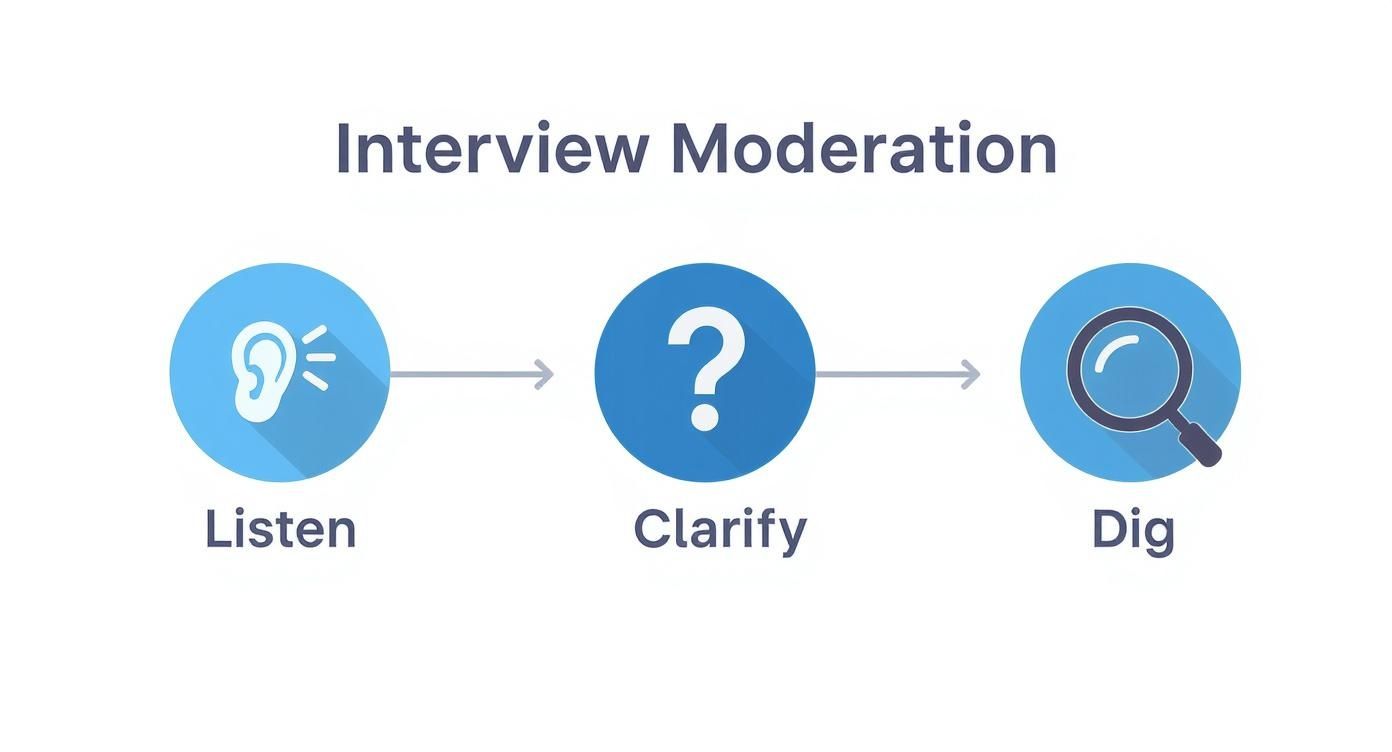
In the interview, you have one job: get them to talk. This is where passionate founders crash and burn. You're so used to pitching that you can't resist "correcting" the user. Every time you say, "Well, actually, what we're trying to do is..." you’ve contaminated the sample and killed the conversation.
Your idea doesn’t need a defense attorney; it needs a ruthless prosecutor. The user is your star witness. Stay out of the way and let them testify.
The takeaway: The moment you start defending your idea, you've lost. Your goal is brutal honesty, not polite applause.
Unlearning Your Worst Habits
To get good at this, you have to unlearn the habits that make you a good founder. Persuading and problem-solving are liabilities here. Your new job is to become an endlessly curious idiot.
- Mirror Their Language: They say "clunky," you say, "Clunky? Tell me more about that." Don't insert your own biased vocabulary.
- Dig for Specifics: Vague feedback like "simpler" is useless. Ask, "When you say 'simpler,' what does that look like? Give me an example."
- Embrace the Awkward Silence: After they answer, be quiet. Count to five. They’ll rush to fill the silence with unfiltered thoughts.
The takeaway: Your job isn't to be a host; it's to be a sponge.
Handling The Inevitable Awkward Scenarios
Interviews go off the rails. A good moderator handles turbulence without panicking. Here's how to manage the three most common interview archetypes.
1. The Silent Participant
Gives one-word answers. It's painful. Don't babble. They're just nervous. Switch from broad questions to hyper-specific, action-based prompts: "Show me exactly how you handled this last time. Can you share your screen and walk me through it?"
2. The Feature Request Machine
Shows up with a list of 17 features they want. Treat every request as a clue. Use the "Five Whys." They say, "You should add CSV exports." You say, "Interesting, why do you need that?" Keep asking "why" until you hit the root cause. The request for an export is often a desperate need for better reporting to their boss.
3. The Person Who Just Doesn't Get It
They've completely misunderstood your concept. Your ego is screaming. RESIST. Their confusion is a hugely valuable data point. Say, "It sounds like I did a poor job explaining this. Tell me what you're thinking. What part is most confusing?" Their misunderstanding signals your messaging or UI is unclear.
Finally, always get consent to record. "Do you mind if I record this so I can focus on our conversation?" I've never had anyone say no.
The takeaway: Every interview challenge is a data point in disguise.
Turn Messy Conversations Into Strategic Ammo
An interview is useless if the insights die in a Google Doc. Most founders are great at talking to users but terrible at synthesis. They finish a week of calls with a vague feeling of "that was interesting," then go right back to arguing over opinions. If you skip this part, you might as well have not done the interviews at all.
The 15-Minute Debrief
The second you hang up, the clock starts ticking. Grab your observer and spend exactly 15 minutes on a debrief.
- What was the biggest surprise?
- What was the most quoted phrase or strongest emotion?
- What was the core problem they kept circling back to?
Each person writes their top three takeaways on sticky notes. The overlap is pure gold.
The takeaway: Crystallize your thoughts immediately before they evaporate.
Tagging Your Notes Like an Intelligence Operative
Go through each transcript and apply simple, actionable tags. You're looking for recurring themes.
PAIN_POINT: A complaint, frustration, or clunky workaround.MOTIVATION: The "why" behind their actions.DIRECT_QUOTE: A sentence so perfect it could go on your landing page.AHA_MOMENT: An insight that makes you see the problem in a new light.
This isn't about being perfect; it's about turning anecdotes into data.
The takeaway: A searchable insight is a thousand times more valuable than a forgotten memory.
From Data Points to Themes
After five or six interviews, you'll see the same tags popping up. Cluster them. The PAIN_POINT from Interview #1 is the same one from Interviews #3 and #5. That's a theme. AI adoption in research is at 80% for a reason—it generates insights 50% faster. You'd be a fool not to use it. These tools spot patterns in minutes, not hours. Don't stop at the product roadmap. Start transforming interviews into killer social media content.
The takeaway: Your goal is a one-page summary your team can actually use, not a 50-page report nobody will read.
Stop Debating and Start Talking
The single biggest mistake you can make now is to read all this, nod sagely, and then go right back to your old habits. All this theory is worthless without action. User interviews are the most direct path from gut-wrenching uncertainty to product-market fit. This isn't a "nice-to-have" skill; it’s a survival tactic.
Every day you put this off, your competitors are out there learning. They're talking to your potential customers, digging into the pains you're ignoring, and building the solutions you're still just debating.
The answers you need aren't inside your building. They’re out there, waiting in the frustrations of the people you claim to serve.
So, stop hiding behind spreadsheets. Stop building in the dark, fueled by ego.
Pick one person from your sign-up list. Send an email. Schedule a call.
Go talk to someone. Right now.
Stop guessing what your customers want and let Backsy's AI analysis show you the patterns hidden in their feedback.
