A Founder's Guide to the New Product Development Process
A no-fluff guide to the new product development process. Learn battle-tested strategies to find problems, build MVPs, and launch products that actually win.
Posted by
 Backsy
Related reading
What Is The Design Thinking Process? A Founder's Guide
What is design thinking process? A clear, no-fluff guide to empathy, ideation, and prototyping that helps you build products customers actually want.
A Founder's Guide to the New Products Development Process That Isn't Total BS
Tired of building products nobody wants? Learn the battle-tested new products development process that separates winning startups from the graveyard.
Voice of Customer Meaning: A Founder's Guide to Not Building Useless Sh*t
Uncover the real voice of customer meaning. This is not another marketing guide—it's a founder's playbook for building products people actually buy.
Building a product isn't a magical journey. It's a brutal filtration system designed to kill bad ideas before they become expensive failures. Here’s the TL;DR in 20 seconds:
- Stage 1: Find & Validate Pain. Stop brainstorming clever features. Find a real, expensive problem people are begging you to solve. If you can't find the pain, you don't have a business.
- Stage 2: Build a Lean MVP. Scope down to the one or two features that directly attack the core pain. Your first build is a scalpel, not a Swiss Army knife. Its only job is to learn.
- Stage 3: Launch Like an Experiment. Use a phased rollout (internal, beta, public). A "big bang" launch is a recipe for disaster. Your goal is to collect data under controlled fire.
- Stage 4: Iterate or Die. Your product is live, now the real work starts. Turn raw customer feedback into your next roadmap. The process never ends.
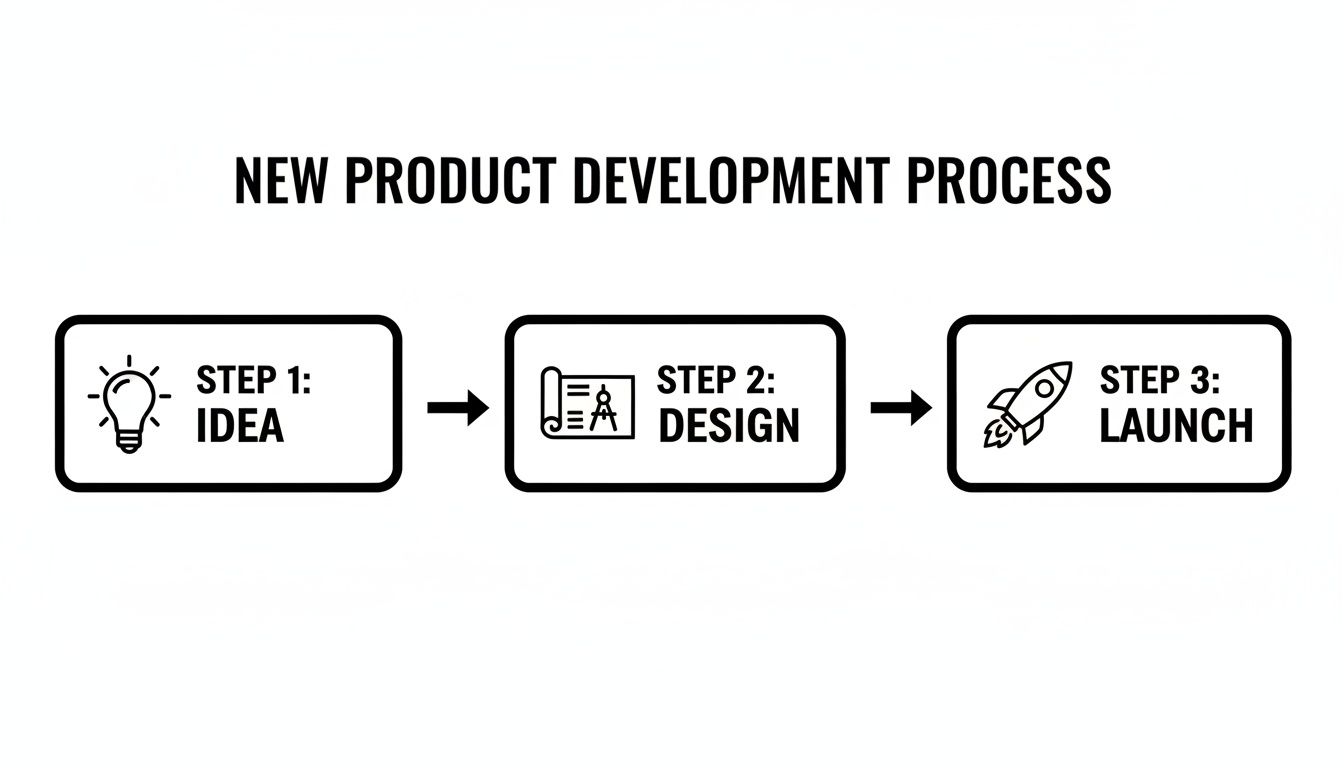
Most guides make the new product development process sound like a rigid, academic exercise. They're filled with jargon and phases that don't match the messy reality of building something people want. This is the practical, battle-tested roadmap we wish we'd had.
Let's dive in.
Stage 1: Finding and Validating the Right Problem
Most products don’t fail from bad engineering. They fail because they’re beautifully built solutions for problems nobody actually has. Your first job isn't to dream up clever features; it's to be a detective, hunting for genuine, high-value pain.
Forget brainstorming. Dig where the pain is loudest: customer support tickets, sales call transcripts, cancellation surveys. Look for patterns. What frustrations pop up over and over? What clunky workarounds are people inventing because your product—or any product—falls short?
Fall in love with the problem, not your solution. A poorly defined problem guarantees a worthless solution, no matter how elegantly it's built.
Once you’ve spotted a recurring theme, validate it. Get on the phone with real people. Don't ask leading questions like, "Wouldn't it be great if...?" Ask about their current workflow and dig into their frustrations:
- "Walk me through how you currently handle [the problem area]."
- "What's the most annoying part of that process?"
- "Have you tried to solve this before? What happened?"
Listen for emotion. Frustration, anger, and sighs of resignation are the sounds of a real, burning problem. A shrug is the sound of a feature nobody will pay for. This stage is critical; some surveys suggest that 28% of product launches fail to meet expectations, which is why you can't afford to guess. This process of validating a business idea is non-negotiable.
Real-World Example: A Pivot from the Brink
I once worked with a B2B SaaS company that was bleeding customers. Their core feature was a complex reporting dashboard they had spent months perfecting. Instead of adding more charts, they analyzed the feedback from every single user who had canceled.
The insight was shocking. The fancy reports weren't the solution. The real pain was the tedious, manual data entry required just to generate those reports. They immediately pivoted their entire roadmap, froze work on the dashboard, and built simple integrations to automate data input. Within two quarters, churn dropped significantly. They stopped solving the problem they assumed customers had and started solving the one customers were actually screaming about.
You can learn more about how to structure this crucial step in our guide on what is product validation.
Actionable Takeaway: Before you write a single line of code, quantify the pain. Find the most urgent, frequently mentioned problems in your feedback, then get on the phone with real users to confirm it's a headache worth solving.
Stage 2: Designing and Building a Lean MVP
You’ve confirmed a real problem exists. Fantastic. Now you’ve reached the most dangerous part of the journey: building the solution. This is where teams go off the rails, burning their budget on a bloated product nobody asked for.
A Minimum Viable Product (MVP) isn't just a cheaper, buggier version of your final vision. It’s a precision-guided experiment. It’s the fastest, leanest way to test your core hypothesis with real users. The goal isn't to build your masterpiece; it's to learn. You have to be absolutely ruthless in cutting the scope down to the one or two features that directly attack the core pain point. Everything else is noise.

Before engineers write a line of code, you need a low-fidelity version of your product. I’m talking basic wireframes and clickable prototypes in Figma or Balsamiq. This is the cheapest way to get feedback on flow and usability.
Your first MVP is a tool for learning, not selling. Its job is to answer your riskiest assumptions as cheaply and quickly as possible. Every feature must serve that purpose.
Putting a clickable prototype in front of a potential customer is priceless. You’ll immediately spot confusing navigation and flawed assumptions—insights that would have taken weeks and thousands in coding to uncover. This is a core part of the what is design thinking process, which champions user empathy and rapid prototyping to de-risk development.
Today's digital tools are a game-changer. As you plan your MVP, explore all resource strategies; understanding software development outsourcing, for example, can help you decide if external expertise makes sense. Research cited by McKinsey shows that digital-twin technologies can slash development times by 20%–50%. Around 58% of product managers now use no-code platforms for quicker prototyping, validating ideas without needing deep technical skills.
Real-World Example: The Hardware Startup Shortcut
I advised a hardware startup building a new smart home device. Instead of sinking $100,000 into manufacturing, they 3D-printed a non-functional but realistic-looking prototype. They built a slick landing page with professional photos of this prototype, a great description, and a big "Pre-Order Now for a 30% Discount" button.
They spent $1,000 on targeted ads. The result? In under a month, they secured over $50,000 in pre-orders. They proved people would pay for their solution before a single functional unit was ever built, funding their entire first production run without giving up a point of equity.
Actionable Takeaway: What's the single biggest, scariest assumption your business relies on? Figure out the absolute cheapest experiment you can run to prove (or disprove) it. It could be a landing page, a prototype, or a manual "concierge" service. Just test it.
Stage 3: Executing Your Launch and Bracing for Impact
The launch isn't the finish line. It’s the starting gun. All your theories, prototypes, and user tests are about to collide with the unfiltered, chaotic world of actual customers.
Don't just flip a switch and hope for the best. A smart launch is phased, controlled, and designed for one primary purpose: learning under fire. This isn't about marketing hype; it's about stress-testing your entire operation—from infrastructure to your onboarding flow.

A "big bang" launch is a luxury for companies with nine-figure marketing budgets. For the rest of us, it’s a recipe for disaster. A phased rollout systematically de-risks the process.
Here’s a battle-tested sequence:
- Internal Alpha: Your own team uses it, breaks it, and finds the embarrassing bugs first.
- Friends & Family Beta: A small, friendly group gives you honest feedback without blasting you on social media.
- Closed Beta (Invite-Only): Your first real test with target customers from a waitlist. Their feedback is gold for refining onboarding.
- Public Launch: Only after you’ve survived the previous stages and patched the major holes do you open the floodgates.
Launching without the right analytics is like flying a plane blindfolded. Your pre-launch checklist must include:
- Product Analytics: Tools like Mixpanel or Amplitude to track user behavior.
- Performance Monitoring: Services that alert you the moment your servers start to buckle.
- A Centralized Feedback Hub: A single place for all qualitative feedback—support tickets, social media mentions, in-app surveys.
Your launch is the single biggest data collection event in your product’s life. Your goal is to capture every signal—good, bad, and ugly—to inform what you build next.
Real-World Example: A Launchpad Meltdown
A team I knew built a slick mobile fitness app. On launch day, a major tech blog featured them. The massive traffic spike immediately crashed their servers for 72 hours. The app was unusable, their App Store rating plummeted, and positive press turned into a public execution.
Their fatal mistake? They skipped the phased rollout. They never load-tested their infrastructure with a smaller beta group. A closed beta with just 500 users would have exposed the server limitations and given them time to fix things before the world was watching.
Actionable Takeaway: Treat your launch as a controlled experiment, not a party. Implement a phased rollout and have your analytics and feedback systems running before you welcome your first user.
Stage 4: Measuring User Feedback and Iterating Relently
The launch party is over. Congratulations. Now the real work begins.
This final, perpetual stage is about closing the loop. It's about building a machine that turns raw customer feedback, messy usage data, and frustrated support tickets into your next product roadmap. Get obsessed with the voice of your customer.

Feedback will pour in from everywhere. Your first job is to separate the signal (real, recurring pain points) from the noise (one-off complaints). Don't just build a backlog of feature requests. Dig deeper. A user asking for "CSV exports" might not care about spreadsheets; they might be desperately trying to integrate your tool into a broken workflow. That's the real problem to solve.
The new product development process never truly ends. It’s a continuous, often brutal, cycle of listening to your customers, building what they need, and learning from your mistakes. Get comfortable with being perpetually unfinished.
Triage all incoming feedback into three buckets:
- Bugs: Things that are clearly broken.
- Usability Issues: Features that technically work but are confusing or clunky.
- New Feature Ideas: Legitimate requests for new functionality.
This simple sorting helps you prioritize. A well-structured customer feedback loop isn’t optional; it’s the engine of your growth.
Recent data shows global R&D spending growth has slowed, putting a tight leash on budgets. Lean, iterative methods are no longer a trendy startup philosophy; they are a survival mechanism. Rapid iteration, fueled by direct customer feedback, is your best defense against budget cuts.
Real-World Example: A Customer Board That Built a Roadmap
A B2B platform was struggling with what to build next. They identified their first 100 power users—the folks who used the product daily. They invited these users to an informal "customer advisory board" on a private Slack channel with a monthly 30-minute call. The product team presented rough ideas and early mockups directly to this group and got brutally honest feedback.
The result? This group co-created the product roadmap for the next 12 months. The team stopped wasting time on features nobody wanted. Their user retention went through the roof because their most valuable customers felt like true partners.
Actionable Takeaway: Stop treating feedback as a complaint to be resolved. Treat it as free consulting from the people who matter most. Systematize its collection, find the patterns, and let your customers guide your next move.
FAQ: New Product Development Process
You’ve got questions, we’ve got blunt answers.
What are the 4 stages of new product development?
Forget the old-school, 7-stage textbook model. In the real world, you move in faster, more agile cycles. The four stages that matter are:
- Problem Validation: Find a real pain people will pay to fix.
- MVP Development: Build the smallest possible thing to prove your solution works.
- Launch & Test: Get your product into users' hands without everything crashing.
- Measure & Iterate: Use real market feedback to decide what to build, fix, or kill next.
What is the most important stage of the new product development process?
Problem validation. End of story. If you get this wrong, everything that follows—design, engineering, marketing—is a spectacular waste of time and money. Building a technically brilliant solution for a problem nobody actually cares about is the number one killer of new products.
How do I reduce risk in the new product development process?
You shrink risk by shrinking your feedback loops. The longer you operate on assumptions without real-world input, the more risk you accumulate.
- Talk to users before you write a line of code.
- Use cheap prototypes to test ideas.
- Build a true, ruthless MVP.
- Launch in phases, starting with a small beta group.
What are the main challenges in new product development?
The biggest challenges aren't technical; they're human.
- Solving a non-existent problem: Founders fall in love with their "solution" without validating the pain.
- Feature creep: Adding "nice-to-have" features that bloat the product and delay launch.
- Ignoring feedback: Believing you know better than your customers after you've launched.
- Poor communication: Misalignment between product, engineering, and marketing teams.
If you've got more than 20 open-ended responses, stop suffering—Backsy scores them in minutes.
