Your Survey Data Analysis is a Waste of Time
Stop guessing and start growing. This guide to survey data analysis cuts the fluff and reveals the unfiltered methods that drive real startup growth.
Posted by
 Backsy
Related reading
Transforming Customer Feedback Analysis with AI in Real-Time
Discover how AI revolutionizes customer feedback collection and analysis, enabling swift, informed decision-making for businesses.
10 Voice of Customer Examples You Can Actually Use
Stop guessing. See 10 real voice of customer examples from surveys, social media, and support tickets to find out what your customers actually want.
A Founder's Guide to Analyzing Survey Data
A battle-tested approach to analyzing survey data. Learn how to turn raw feedback into actionable insights that drive real business decisions.
Let’s be honest. You send a survey, skim for the parts that make you feel smart, and paste the prettiest chart into Slack. “See? They love it!” you announce, conveniently ignoring the mountain of criticism that could actually save your company.
You're not looking for truth; you're looking for validation. That's the deadliest addiction in a startup.
This isn’t about the fluffy advice to "listen to your customers." This is about the brutal, cash-burning reality of not listening. Ignore what your customers are really saying, and you’ll be lucky to survive the quarter. The problem isn't the data; it's your confirmation bias turning life-saving feedback into a vanity project.
Why Your Customer 'Insights' Are Probably Worthless
Most founders treat survey data like a drunk uses a lamppost—for support, not illumination. You’re not digging for truth; you’re hunting for compliments.
This isn't just lazy; it’s expensive.
The Feature That Almost Torched Our Runway
Early on, we asked users what they wanted next. A huge percentage voted for an "Advanced Reporting Dashboard." It had all the bells and whistles. We sank three months and a painful chunk of our runway into building it.
Launch day: crickets. Usage was abysmal.
Confused, we did what we should have done first: we called them. The truth was a gut punch. They didn't want a "dashboard"; that was just the corporate-speak we offered. What they really needed was a simple, one-click CSV export of two specific data points to show their boss.
We built a solution for the problem we wanted them to have, not the one they actually had. That's the difference between a survey that validates your ego and a survey data analysis process that uncovers profitable truths.
The Seductive Trap of Bad Data
This mistake is fueled by a few lazy habits. It feels like progress, but it's just motion without direction.
- Asking Leading Questions: "How much do you love our amazing new feature?" is a plea for compliments. Ask "Describe your experience using our new feature" if you actually want to learn something.
- Worshipping the NPS Score: Your Net Promoter Score is a weather report. It tells you if it's sunny or stormy, but it doesn't tell you why. A high score can easily hide deep-seated problems.
- Celebrating 'Good' Data: The most dangerous feedback tells you you're doing a great job. It makes you complacent. The real gold is buried in the angry rants and "I wish it could..." comments.
Understanding your Voice of Customer data isn't a good idea; it's a survival tactic. Stop treating feedback as a report card and start treating it as a treasure map.
Takeaway: Stop looking for data that makes you feel good and start hunting for the feedback that makes you uncomfortable—that’s where the money is.
The Unsexy But Critical Cleanup Job
So, you have a pile of survey responses. The impulse is to jump straight into making charts. Don't.
Raw survey data is a mess of one-word answers, incoherent rants, and typos. The real work isn't in a fancy dashboard; it’s rolling up your sleeves and cleaning the data first. Skipping this is like building a house on a shaky foundation.
This is the non-negotiable part of survey data analysis. It's the gritty work that separates a successful analysis from one that leads you down the wrong path.
Wiping Away the Grime Before You Dig In
Before you can analyze anything, you have to take out the trash. Address common data integrity problems by ruthlessly filtering out the noise.
- Gibberish & Spam: "asdfghjkl" or promotional spam? Gone.
- Incomplete Answers: The person who started a sentence and never finished? Delete it. Don't waste time guessing what they meant.
- The Emoji-Only Crowd: A single fire emoji is nice, but it’s not actionable data. Thank them and move on.
The point isn't to delete feedback you dislike. It's to methodically remove responses that offer zero analytical value.
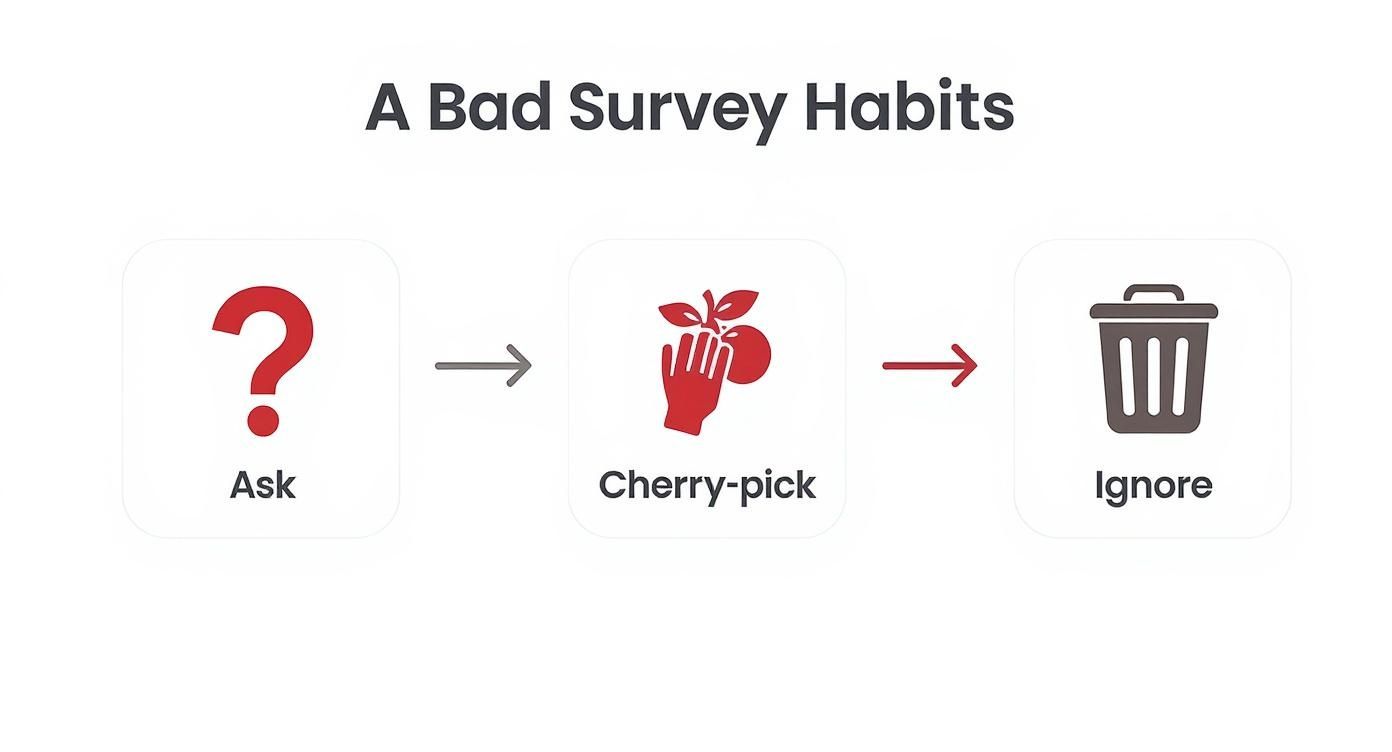
It’s surprisingly easy to produce a report that validates a bad idea, all because the initial data was messy or filtered with bias.
Turning Rants into Roadmaps with Coding
After you’ve cleared out the junk, you're left with a wall of text. This is where you turn qualitative feedback into something you can count. The process is called coding.
Forget fancy software. A spreadsheet is all you need. I use a simple four-category system for sorting open-ended feedback:
- Product Gaps: A problem our product could solve but doesn't. This is where you find your next big features.
- Bugs: Something is broken. These are immediate priorities.
- Feature Requests: An explicit ask, like "I wish you had a dark mode."
- User Error / Confusion: The user is struggling with something the product already does. This is a signal that your UI/UX or onboarding sucks.
A "codebook"—a simple document defining your tags—is your best friend. It ensures you and your team tag comments consistently. This forces you to actually engage with what users are telling you, transforming a messy pile of words into a structured dataset.
Takeaway: Raw data is a liability; clean and coded data is an asset worth fighting for.
Stop Looking at Averages and Start Segmenting
Your average satisfaction score is 4.2 out of 5. Great. What does that actually tell you? Nothing. That single number is a vanity metric that hides the most critical problems buried in your data.
Averages are statistical sedatives. Real survey data analysis starts when you stop admiring the average and start slicing your data until it bleeds insight.

We're talking about basic cross-tabulation—a fancy term for comparing how different groups answered the same questions. Ignoring it means you're just guessing.
Your Customers Are Not a Monolith
The moment you treat all users the same, you start building a product for no one. Your user base is a collection of distinct tribes. Your job is to find them.
Start by splitting results by impactful segments:
- By Plan Type: Do your enterprise customers have different problems than free users? Spoiler: they do. Their feedback is worth 100x more.
- By Usage Frequency: How do daily power users feel compared to weekly visitors? One group lives in your product; the other is just visiting.
- By Company Size: Is your product a hit with 20-person startups or 200-person scale-ups? The answer should drive your entire GTM strategy.
Think of it like a doctor. They don't take an "average" of all your symptoms. They isolate variables to find the root cause. Segmentation is your diagnostic tool.
From Vague Data to Specific Action
Once you start cross-tabulating, the noise fades. You'll stop seeing "some users want a better dashboard" and start seeing "78% of our enterprise users who signed up in the last 90 days are struggling with the reporting feature."
Which of those gives you a clear mandate to act?
This isn’t some niche skill. There's a reason projections show that worldwide spending on statistical analysis software is expected to hit US$10.35 billion. As this market report on data analysis tools explains, companies are realizing that simple tools uncover million-dollar insights.
If your overall Customer Satisfaction (CSAT) score looks fine but it’s tanking among users on your highest-paying tier, that's a five-alarm fire. Getting a handle on the most critical customer satisfaction metrics in our article is a good place to start.
The point of survey analysis isn't to create a report. It's to find a specific, data-backed, money-making action.
Takeaway: Averages are for amateurs; segmentation is where you find the pockets of intense rage and intense love that will define your business.
Finding Gold in Angry Rants and Weird Compliments
That open-ended text box at the end of your survey? It’s where your customers are telling you, in their own words, what they'd pay for. Yet most founders see that wall of text, their eyes glaze over, and they jump back to the vanity metrics.
That's a massive mistake. This is where you find the why behind your numbers.

And please, forget about word clouds. They’re a design gimmick, not an analysis tool. Seeing the word "dashboard" pop up 50 times tells you nothing about the actual problem. We're hunting for product strategy, not making art.
Think Business Archeology, Not Data Science
Treat this part of your survey data analysis like business archeology. You’re digging through dirt—the typos, the rants, the oddly specific compliments—to unearth artifacts that will shape your company's future.
You don't need fancy NLP tools to start. You need a spreadsheet and a simple tagging system.
- Read every single response. I mean it. Don't skim. Absorb the feedback until you feel the customer's pain in your gut.
- Create thematic tags as you go. Recurring ideas will jump out. Create simple tags like
UI_Confusion,Billing_Issue, orOnboarding_Pain. - Tag everything. A single frustrated message might get tagged with
Bug_Report,Slow_Performance, andUI_Confusion.
This manual process forces you to internalize what people are telling you. You'll start to see connections between comments that seemed unrelated. That’s not a coincidence; that’s a roadmap.
Translating Complaints into Feature Specs
Your angriest customers are often your most passionate users. They’re mad because they want to use your product, but something is in their way. Their rants are just poorly written feature requests.
Your job is to translate their emotional language into a technical spec.
| What the Customer Says | What They're Actually Asking For |
|---|---|
| "Your reporting is useless! I can't find anything!" | "I need a search or filter function in the reports." |
| "Why is it so hard to add a new team member? I give up." | "Simplify the user invite flow; it has too many steps." |
| "I love the product but I have to manually copy-paste data." | "Build an integration with Salesforce or Google Sheets." |
Sentiment analysis is a starting point, not the answer. It tells you if a customer is happy or mad, but not if their feedback is valid. Context is everything.
This challenge is universal. Recent survey data analysis in the public sector found their biggest roadblock isn't cost—it's compliance. Even governments are realizing user feedback is critical, but context shapes the problem. You can dig into these public sector data trends and hurdles to see what I mean. For you, the hurdle isn't compliance; it's ignoring the subtext of a complaint.
One person’s rant often represents the silent frustration of a hundred others who just canceled their subscription without saying a word.
Takeaway: The most valuable feedback is almost always disguised as a complaint; learn to translate anger into a product roadmap.
The One-Page Report Your Team Will Actually Read
Nobody has time to read your 50-slide PowerPoint deck. Stop wasting everyone's life with bloated reports that nobody asked for. These documents become monuments to your own effort, not tools for making better decisions.
The point of survey data analysis isn't to create a history book of customer sentiment. It’s to find a single, powerful lever and pull it. Your final report should be a weapon, not a research paper—sharp, concise, and aimed directly at a business problem.
I've watched founders present hour-long dissertations on survey findings while their company quietly burned. They get so caught up in twenty "interesting" things that they fail to highlight the one thing that actually matters. This isn't an academic exercise. It's a rescue mission.
The Three-Part Weapon
Your report must fit on a single page. If you can't make your point in that little space, you don't have a clear point.
It must contain exactly three things:
- The Shocking Insight: The one statistic or theme that made you say, "whoa." The uncomfortable truth.
- The Undeniable Evidence: One chart that illustrates the insight so clearly a five-year-old could get it. Or a few verbatim customer quotes that hit with emotional impact.
- The Recommended Action: Not "next steps." The single, unambiguous thing the team should do right now.
You are a translator, not a librarian. Your job is to convert a flood of noisy data into a single, clear marching order. Complexity is the enemy of execution.
Ruthless Prioritization in Action
You found 20 interesting things? Great. Throw 19 of them in the trash. Your team can only focus on one thing at a time. Pick the one insight with the biggest potential impact on revenue, churn, or growth.
A useless takeaway: "Users are having a mixed experience with our new UI."
Instead, your one-pager should scream this:
- The Shocking Insight: 72% of enterprise trial users who cancel do so within 48 hours of trying to set up team permissions.
- The Evidence: A simple bar chart showing the user drop-off, next to a quote like: "I have a PhD and I couldn’t figure out how to add my team. We just went back to spreadsheets." – Former User, Acme Corp.
- The Recommended Action: This week, pause all other feature work and redesign the team invite flow into a one-click process.
See the difference? One is a vague observation. The other is a battle plan.
Even massive organizations like The World Bank rely on this. They distill sprawling data into sharp insights—like rising digital payment adoption—to guide specific strategies. You can see how they turn a world of data into targeted actions by exploring the World Bank’s Global Findex findings. Your job is to provide that same clarity for your own battlefield.
Takeaway: Stop delivering data dumps. Deliver a single, weaponized insight with a clear call to arms.
No-Nonsense FAQ for Founders
Let's cut the crap. You have questions, you don't have time for a textbook answer.
How Often Should We Run Surveys?
Forget a rigid schedule. Timing is everything. It's about triggers, not calendar dates.
- New Users: Reach out 14 days after they sign up. They've had enough time to form a real opinion but haven't forgotten onboarding.
- Churned Users: Send a survey within 48 hours of cancellation. The reasons they left are still fresh and raw.
- Power Users: Survey them right after they've used a key feature for the third time in a week. They're in the zone and can give specific insights.
As for general "pulse" surveys? Once a quarter is plenty, but only if you actually do something with the answers. Otherwise, the right frequency is never.
What Is a Good Enough Response Rate?
Wrong question. It’s a vanity metric.
Would you prefer a 40% response rate from free-trial users who will never convert, or a 5% rate from the enterprise clients who make up 80% of your revenue? The answer is obvious. It’s not how many respond; it’s who responds.
Focus on the feedback from the segments that drive your business. The feedback from your top ten customers is worth more than a thousand responses from the wrong crowd.
A small, engaged group of the right people gives you a clearer roadmap than a giant, indifferent crowd. Stop chasing volume and start chasing relevance.
Can AI Just Do This Analysis For Me?
Yes and no. Think of AI as a brilliant, incredibly fast intern who lacks business context.
Use it for the heavy lifting. AI is fantastic at plowing through thousands of comments, spotting trends, and grouping feedback into themes in minutes. Use it for that first, grueling pass.
But you absolutely cannot let it make the final call. AI doesn’t know that the one "minor complaint" about an API bug came from your largest customer whose contract is up for renewal.
Use AI to process the data. Then, use your founder’s brain to connect the dots and decide what to do next. It's a tool to multiply your effort, not replace your judgment.
What Is the Biggest Mistake Founders Make?
Asking for opinions instead of facts.
"Do you like our new dashboard?" is a useless question. It's fishing for a compliment.
A much better question is, "Tell me about the last time you tried to find a specific report." This is a goldmine. It forces them to recall an actual experience, revealing friction and frustration.
People are terrible at predicting their future behavior but amazing at telling stories about what they've already done. For a complete walk-through on turning this kind of raw data into insights, this step-by-step guide on how to analyze survey data is a great resource. Stop asking for predictions and start digging for real stories.
Stop drowning in feedback spreadsheets and let Backsy.ai pinpoint your customers’ most profitable demands in minutes.
